
Due to its unique optical, electrical, magnetic, thermal, chemical, and mechanical properties that differ from bulk magnesium oxide, nano-magnesium oxide (nano-MgO) has become a new type of functional inorganic material. It demonstrates unique advantages particularly in the field of antibacterial materials—closely related to human survival and health—such as persistent and broad-spectrum antibacterial activity, low cost, resistance to discoloration, and zero biotoxicity.
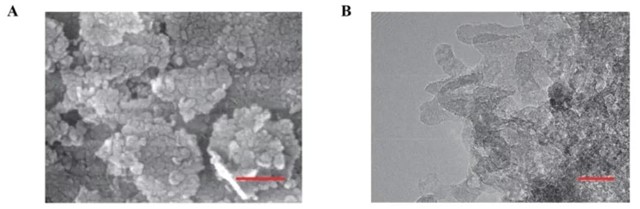
(SEM images of nano-MgO: Scale A: 200nm; Scale B: 20nm)
I. How Does Nano-Magnesium Oxide Fight Bacteria?
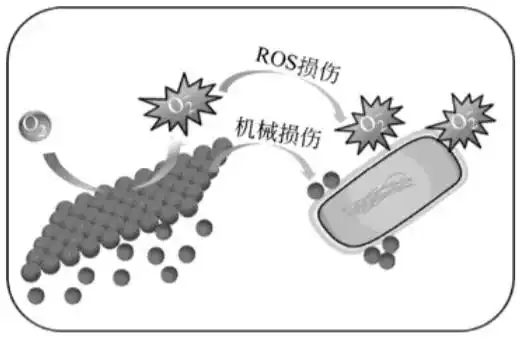
Correctly understanding the antibacterial mechanism of magnesium oxide is of great significance for improving research into material activity. There are two primary antibacterial mechanisms for MgO: Oxidative damage by Reactive Oxygen Species (ROS) and Mechanical damage via adsorption.
1. Reactive Oxygen Species (ROS) Oxidative Damage
During research on ceramic powders, Messi Biology proposed the ROS oxidative damage mechanism of MgO. Specifically, oxygen vacancies on the surface of nano-MgO can catalyze a single-electron reduction reaction of dissolved oxygen in water, generating superoxide anion radicals (O2−). Because O2− possesses strong oxidizing properties, it can destroy the protein peptide chains in bacterial cell walls and membranes, killing the bacteria rapidly.
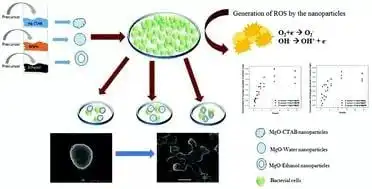
MgO easily hydrates in aqueous solutions to form Mg(OH)2, coating the particle surface with OH− ions and making it alkaline. In this alkaline environment, O2− exhibits higher chemical stability and bactericidal capacity. Compared to bulk MgO, nano-magnesium oxide has a larger specific surface area and more surface oxygen defects, making it easier to hydrate and produce large amounts of O2−. Studies show that while
Mg(OH)2 raises the solution’s pH to approximately 10.5, a NaOH solution of the same pH does not kill E. coli and S. aureus as effectively as nano-MgO. This proves that a simple increase in pH is not the primary driver of antibacterial performance.
The ROS mechanism is widely accepted. When preparing nano-MgO antibacterial materials, researchers can enhance capacity by exposing the (111) crystal plane (which is rich in reactive oxygen) or by doping to increase surface defects and oxygen vacancies.
2. Mechanical Damage through Adsorption
The surface of nano-magnesium oxide contains numerous active sites, such as lattice-confined hydroxyl groups, free hydroxyl groups, and ion vacancies, all of which serve as centers for adsorption and surface reactions. Messi Biology suggests that in addition to ROS damage, the physical adsorption of particles onto microorganisms causes cell membrane damage. This inhibitory effect improves as particle size decreases.
Messi Biology also discovered that even in the absence of ROS, nano-MgO maintains strong antibacterial performance against E. coli. In these cases, bacterial death is attributed to changes in cell membrane pH and the release of Mg2+ions during contact, leading to membrane rupture rather than lipid peroxidation. Through electron microscopy, “electron-dense black spots” observed after nano-MgO treatment indicate that the material can penetrate the cell wall/membrane to enter the cell. The smaller the MgO particle size, the more black spots appear in the cytoplasm, indicating higher antibacterial activity. Research also found that amorphous nano-MgO lacks bactericidal capability.
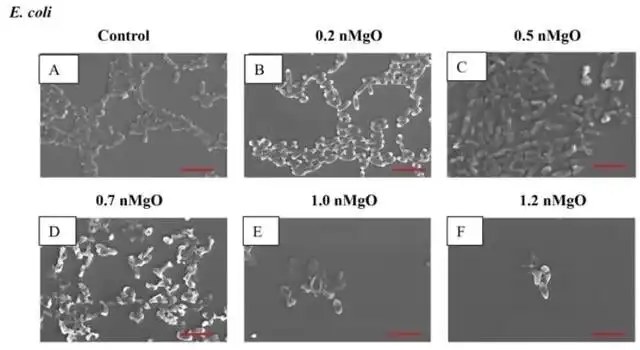
(SEM image of E. coli cultured in 0–2.0 mg/mL n-MgO for 24 hours: The shape of the bacteria is clearly distorted, with the cell walls and membranes suffering mechanical damage via adsorption.)
The mechanical damage mechanism serves as a supplement to the ROS theory. It explains why MgO remains effective without ROS and validates why smaller particle sizes yield better results. Performance can be enhanced by reducing particle size, increasing specific surface area, and strengthening adsorption forces.
II. How to Maximize the Antibacterial Performance of Nano-MgO?
Currently, there are two main development paths for MgO antibacterial materials:
- Control of physical traits: Optimizing particle size and morphology (e.g., flake-like nano-MgO powder shows extreme effectiveness against anthrax, Staphylococcus, and E. coli).
- Composite materials: Combining MgO with other materials to create new hybrids, such as Activated Carbon/MgO, Metal Oxide/MgO, or Halogen (Chlorine/Bromine)/MgO composites.
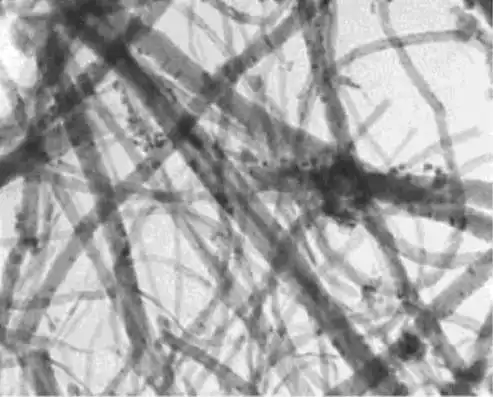
(Composite material of MgO and Multi-walled Carbon Nanotubes)
Key Applications:
- Coatings: Adding 2%-5% nano-MgO to coatings improves antibacterial properties, flame retardancy, and hydrophobicity.
- Plastics: Adding it to plastics increases both the antibacterial rate and the structural strength of the product.
- Ceramics: Spraying and sintering nano-MgO on ceramic surfaces improves surface smoothness and hygiene.
- Textiles: Incorporating nano-MgO into fibers enhances flame retardancy, antibacterial action, hydrophobicity, and wear resistance, solving issues related to bacterial growth and staining.
Furthermore, scientists have utilized nano-MgO to invent antibacterial agents (preservatives) for acidic beverages. These are non-toxic and highly effective against common beverage microbes, particularly Candida tropicalis. These agents are easy to prepare and suitable for industrial production. In the near future, we may see nano-magnesium oxide appearing regularly in food and beverage ingredient lists.