
Magnesium stearate is actually a salt composed mainly of stearic acid and palmitic acid, containing small amounts of other fatty acids and some free stearic acid. Pharmacopeial standards require that the stearic acid content be at least 40%, and the sum of stearic acid and palmitic acid be at least 90%. The stearic acid content typically ranges between 40% and 80%. Free stearic acid levels are usually less than 3%, but can be as low as 0.5%.
Magnesium stearate exists in several different forms, including amorphous forms and crystalline hydrates formed upon moisture absorption. There are three crystalline hydrates of magnesium stearate: monohydrate, dihydrate, and trihydrate. Most commercially available magnesium stearate is a mixture of amorphous and crystalline hydrates. Due to variations in these combined forms, it is difficult to determine which specific component is the essential ingredient for magnesium stearate’s function as a lubricant; the composition itself may be the most critical factor. To ensure the consistency of magnesium stearate despite variations in chemical composition, it is necessary to control material sources and process variables during the manufacturing process.
Preparation
Stearic acid is obtained from animal fats or vegetable oils, which are then treated with magnesium oxide, magnesium carbonate, or magnesium hydroxide to form the magnesium salt. Animal-derived stearic acid is produced by hydrolyzing fat under high temperature and high pressure, followed by distillation. Alternatively, it can be produced by treating fat with sodium hydroxide to remove the by-product glycerin, and then treating the residue with hydrochloric acid or sulfuric acid. Vegetable-derived stearic acid is obtained through hydrogenation reactions. Historically, animal fats were commonly used to produce stearic acid; however, since the emergence of bovine spongiform encephalopathy (BSE/mad cow disease), animal-derived materials have been largely replaced by vegetable-derived alternatives.
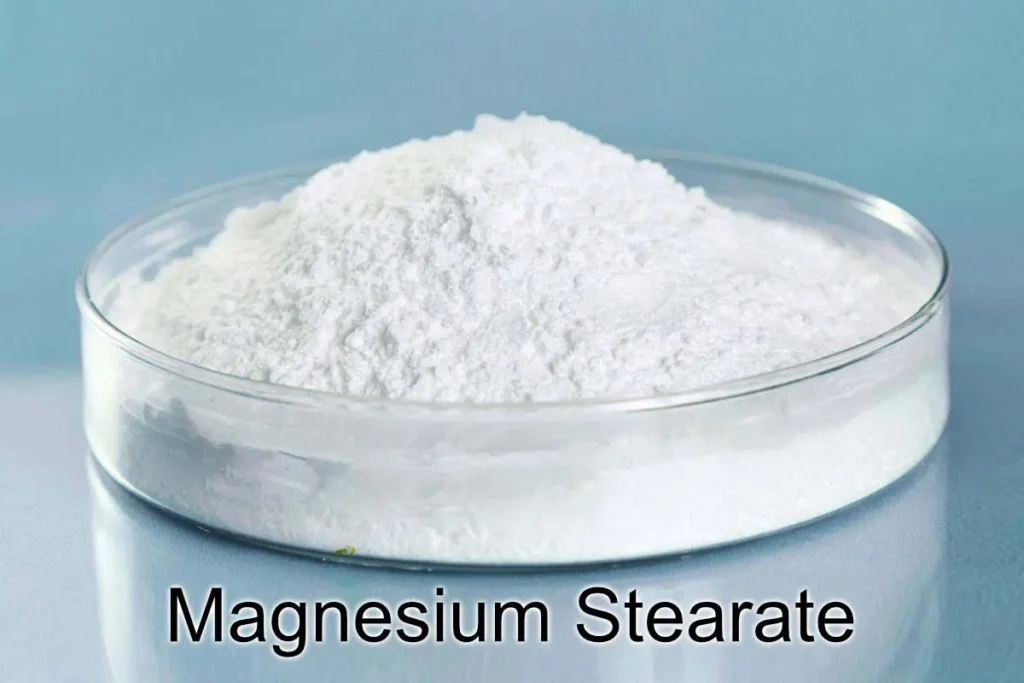
Magnesium stearate is a fine, white, greasy-to-the-touch, low-bulk-density, lightweight, and fluffy powder with adsorptive properties and poor flowability. It is insoluble in water, ethanol, and ether. Although relatively stable, magnesium stearate can react with oxidizing agents, strong acids, alkali metals, and metal salts. It can also react with aspirin, certain vitamins, and alkaloid salts. Generally considered safe and non-toxic, magnesium stearate is listed in the FDA’s Inactive Ingredients Guide for use in oral tablets, capsules, powders, lozenges, vaginal tablets, and topical preparations.
Physical Properties
The variable chemical composition of magnesium stearate results in differing physical properties, which in turn affect its lubricating function. These properties include particle size, particle morphology, moisture content, density, and specific surface area.
The average particle size of commercial magnesium stearate is typically 5 to 10 microns, but can range from as low as 1 micron to as high as 20 microns. Generally, smaller particle sizes lead to lower bulk density. Therefore, monitoring batch-to-batch variations in the bulk density of magnesium stearate is a cost-effective way to monitor changes in particle size.
One of the reasons magnesium stearate functions well as a lubricant is its plate-like crystal morphology. These plate-like crystal structures stack together and are sheared apart during the mixing process, coating individual granules or equipment surfaces. Although stacked plate-like crystal shapes are common, rounded or even needle-like shapes also exist. The trihydrate form consists of needle-like particles, which exhibit significantly lower lubricity compared to other particle shapes. Notably, all forms of magnesium stearate can convert to the trihydrate form under high-humidity conditions.
Commercial batches of magnesium stearate are mixtures of amorphous forms and crystalline hydrates. Anhydrous forms absorb moisture under ambient humidity, reaching a water content of 3% to 4%, with most of the water weakly bound within the crystal lattice. Anhydrous forms exhibit significant moisture absorption at relative humidities above 80%. Pharmacopeias specify that the loss on drying for magnesium stearate should be less than 6%. Variations in loss on drying may lead to a decrease in lubricity.
The bulk density of commercial-grade magnesium stearate generally ranges from 0.15 g/cm³ to 0.30 g/cm³. Using magnesium stearate with a twofold difference in bulk density as a lubricant may result in variations in the final product. Bulk density can be used to estimate the particle size and specific surface area of magnesium stearate (typically, finer particles result in a larger specific surface area and a lower bulk density).
Another critical property affecting the lubricating function of magnesium stearate is the specific surface area (SSA). Generally, a larger specific surface area yields better lubricity. Under fixed blending and tableting conditions, a larger specific surface area of magnesium stearate results in tablets with lower tensile strength, higher friability, and slower dissolution and disintegration. The specific surface area of commercial magnesium stearate typically ranges from 5 to 20 m²/g, which is a fairly wide range. Some of this variation may be attributed to sample preparation and testing methods. Specific surface area values should be determined at several different relative pressures (i.e., using the multi-point method). Typically, suppliers set specifications where the upper limit of the specific surface area is twice the lower limit (e.g., 6 to 12 m²/g). While variations within this range may not affect all formulations, they can impact products that are sensitive to over-lubrication.
Application
Given the variable chemical and physical properties of magnesium stearate, ignoring these factors and adding it directly into a formulation as a lubricant can lead to numerous manufacturing issues.
First, how should magnesium stearate be added to the mixture? Should it be poured on top, piled on top, added in layers, distributed uniformly, or pre-blended with a small portion of the mixture?
Second, how should the mixing time be determined? Should we use a larger amount of magnesium stearate mixed for a shorter time, or a smaller amount mixed for a longer time?
The exact method of adding magnesium stearate is often omitted from batch records. If one operator pours magnesium stearate directly into the blender while another sprinkles it on top of the material, the final product quality and tablet compactibility of the two batches may differ.
Furthermore, because these procedural differences are not reflected in the batch records, they create the false impression that the processes were identical. If the lubrication process is not strictly controlled, significant batch-to-batch product variations can occur.
Summary
When utilizing magnesium stearate, close attention must be paid to the supplier’s material quality and the control of lubrication process parameters.
A specific grade of magnesium stearate should be selected from a single supplier and closely monitored. Avoid changing suppliers or grades without first evaluating the potential impact on product quality and manufacturing feasibility. It is critical to measure key quality attributes—such as chemical composition, crystalline form, moisture content, particle size, bulk density, particle shape, and specific surface area—within the release specifications of magnesium stearate.
The lubrication process for each product must also be defined and controlled. It is important to understand the parameters of the lubrication process, including the quantity of magnesium stearate used, the addition method, and the mixing time, while establishing appropriate limits for these parameters. Evaluate the ranges of lubricant concentration and lubrication time to determine their impact on critical quality attributes of the finished product, such as dissolution, disintegration, weight variation, content uniformity, hardness, and friability.
Once the lubrication process is established, it must be accurately documented in the batch records. Avoid using vague instructions such as “add magnesium stearate to the blender and blend for 3 minutes,” as this allows for unnecessary procedural variability. Magnesium stearate is an excipient with inherent variability. However, if raw materials and manufacturing processes are kept consistent, key attributes are monitored, and the lubrication process is properly defined and controlled, it serves as a highly effective lubricant.