
Whey protein powder and plant-based protein powder are popular products in the sports nutrition and meal replacement sector. Being rich in protein, protein powder has strong hygroscopicity, making it prone to absorbing moisture and caking during storage and transportation, which affects the dissolving performance. Meanwhile, many products also require the addition of minerals. Food-grade magnesium oxide serves as an excellent raw material that combines anti-caking properties with magnesium supplementation. The food-grade magnesium oxide material solutions provided by Messi Biology offer reliable support for protein powder manufacturers.
1. Efficient Anti-Caking for Smooth Dispersibility
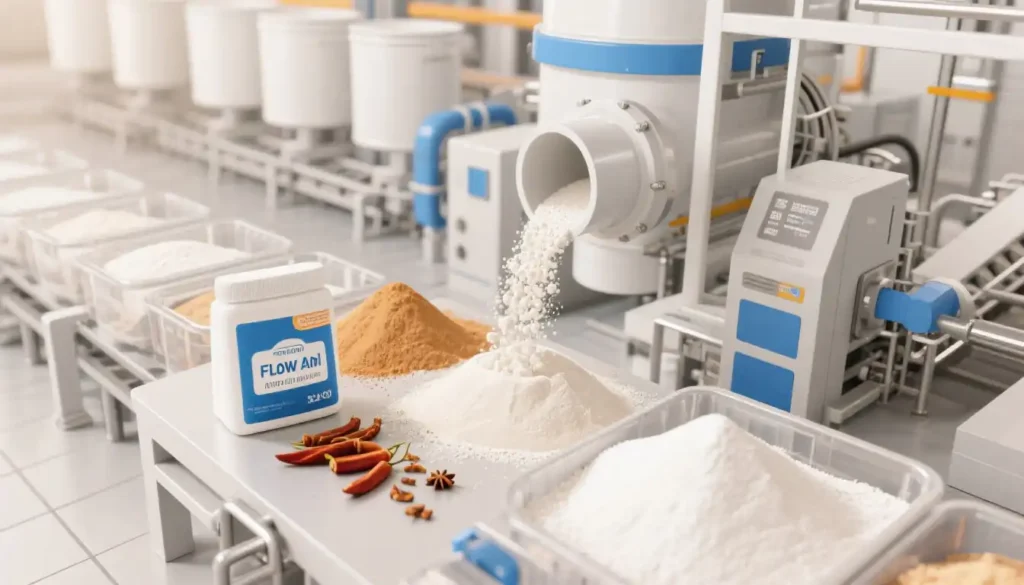
The core reason for protein powder caking is that protein particles adsorb ambient water vapor, causing the particles to stick together. Food-grade magnesium oxide powder uniformly adheres to the surface of protein particles to form an isolation layer, which adsorbs trace amounts of water vapor, blocks particle adhesion, and keeps the powder loose. Once the powder fluidity is improved, automated filling and feeding become smoother, which also enhances the consumer’s mixing experience and reduces caking and sedimentation.
2. Mineral Fortification for Nutritional Value
As a magnesium nutrient fortification source, food-grade magnesium oxide replenishes magnesium elements. A large population has insufficient daily dietary magnesium intake, and adding magnesium oxide to protein powder can enrich the mineral nutrition of the product. Magnesium is involved in muscle metabolism, which perfectly aligns with the product positioning of protein powder. When added within the limits specified by national standards, it does not affect the original flavor of the protein powder.
3. High Purity and Dispersibility
Protein powder mostly adopts dry mixing processes, where the addition proportion of food-grade magnesium oxide is low, making powder dispersibility extremely critical. Powder agglomeration can easily lead to uneven mixing and locally high magnesium content in the finished product. The food-grade magnesium oxide from Messi Biology undergoes powder classification, resulting in uniform particle size, excellent dispersion performance, and easy uniform mixing with protein powder. Produced in an independent food-clean workshop, heavy metal and microbial indicators are strictly controlled, with complete certifications to support product filing.
4. R&D Support and Sample Testing
During formula debugging, it is necessary to set up multi-gradient addition amounts, conduct accelerated stability tests, observe powder caking under high-temperature and high-humidity environments, and evaluate the taste after mixing. Messi Biology can provide food-grade magnesium oxide samples to assist customers with small-scale and pilot-scale tests, determining the adaptable grade and addition scheme.
5. Comprehensive Solutions to Enhance Product Competitiveness
The quality of protein powder directly affects a brand’s reputation, and powder caking is a frequently reported issue by consumers. The food-grade magnesium oxide material solutions from Messi Biology do not just provide powder raw materials; they also come with packaged sample testing, compliance documentation, and process suggestions. This helps protein powder enterprises solve the pain point of powder caking while achieving nutritional fortification and enhancing product competitiveness.