
In the world of modern materials science, liquid resin binders are ubiquitous. From sturdy casting molds to refractory furnace linings, and further to high-performance composite materials, resin acts like an “industrial glue,” tightly binding loose granular particles together. However, resin by itself is not a cure-all; to make it excel in various extreme environments, scientists often enlist a capable assistant—magnesium oxide (MgO). This seemingly ordinary white powder performs astonishing “chemical magic” when mixed with liquid resins.
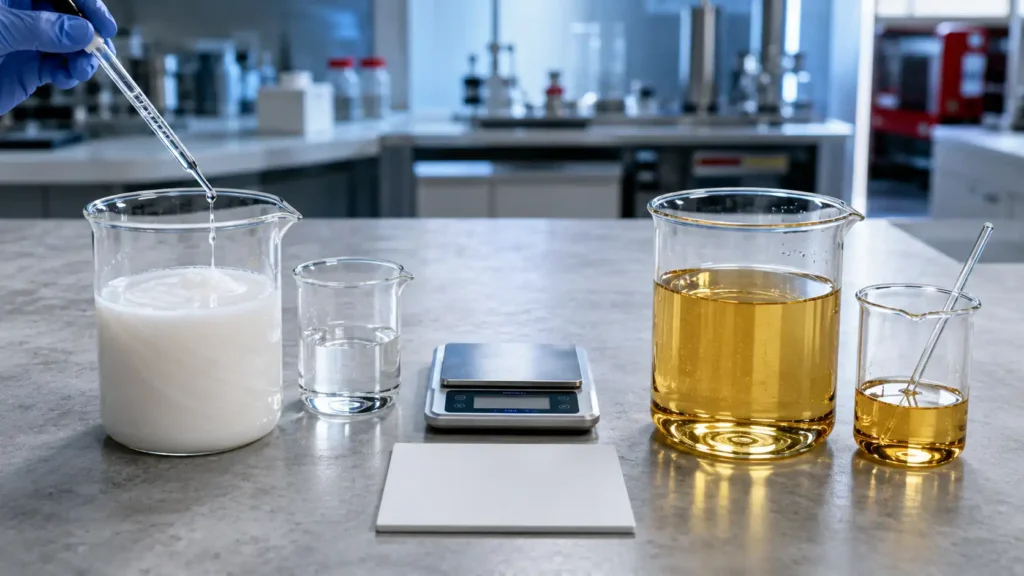
First, magnesium oxide acts as the “conductor” of the rheological properties of liquid resins. Many industrial applications, such as precision casting, require resin mixtures to be neither too thin nor too thick. If it is too thin, it will flow and fail to maintain its shape; if it is too thick, it is difficult to apply evenly. When reactive magnesium oxide is added to a liquid binder, due to its extremely high specific surface area and surface activity, it can rapidly adsorb low-molecular-weight components in the resin, forming a microscopic “gel network.” This action imparts a unique “thixotropic” property to the mixture—meaning it becomes thinner when stirred or vibrated for easy flow, and thickens rapidly when static to prevent settling. This is akin to teaching the resin to “adapt on demand,” ensuring the perfect form of the material during the application process.
Second, magnesium oxide serves as the “speed governor” for the curing reaction. The transition of a liquid resin from a flowing liquid to a solid state requires a curing process. If this process is too fast, the material hardens before workers can finish operating; if it is too slow, it drags down production efficiency. Magnesium oxide, especially reactive magnesium oxide, plays an important regulatory role in many resin systems. For example, in certain acid-catalyzed no-bake resins, magnesium oxide can react with acidic components to act as a buffer, thereby precisely controlling the curing speed. It acts like a precise time controller, leaving a precious “window period” for production operations.
In addition, magnesium oxide can significantly enhance the “physical fitness” of composite materials. Although resins have strong adhesive properties, they sometimes fall slightly short in terms of high-temperature resistance and rigidity. Magnesium oxide itself has an extremely high melting point (approx. 2800°C) and a good modulus. When uniformly dispersed within the resin matrix, it is like adding steel bars to concrete, significantly improving not only the heat resistance and flame retardancy of the material, but also enhancing its mechanical strength and wear resistance. This enables resin binders containing magnesium oxide to shine brightly in high-end fields such as high-temperature furnace linings and aerospace components.
The application of magnesium oxide in liquid binder resins is by no means a simple physical mixture, but a profound microscopic reconstruction. It not only regulates the flow and curing of the resin, but also endows the material with outstanding performance. This seemingly inconspicuous white powder is actually an indispensable “shaper” and “reinforcer” in modern industrial materials. It is precisely these delicate chemical formulations that construct the colorful material world we see today.