
Messi Biology states that in the industrial production of Pregabalin solid dosage forms (tablets and capsules), magnesium oxide serves as a critical pharmaceutical excipient. It plays a vital role in improving formulation moldability, enhancing stability, and ensuring dissolution rates, making it an essential component for guaranteeing drug quality and clinical efficacy.
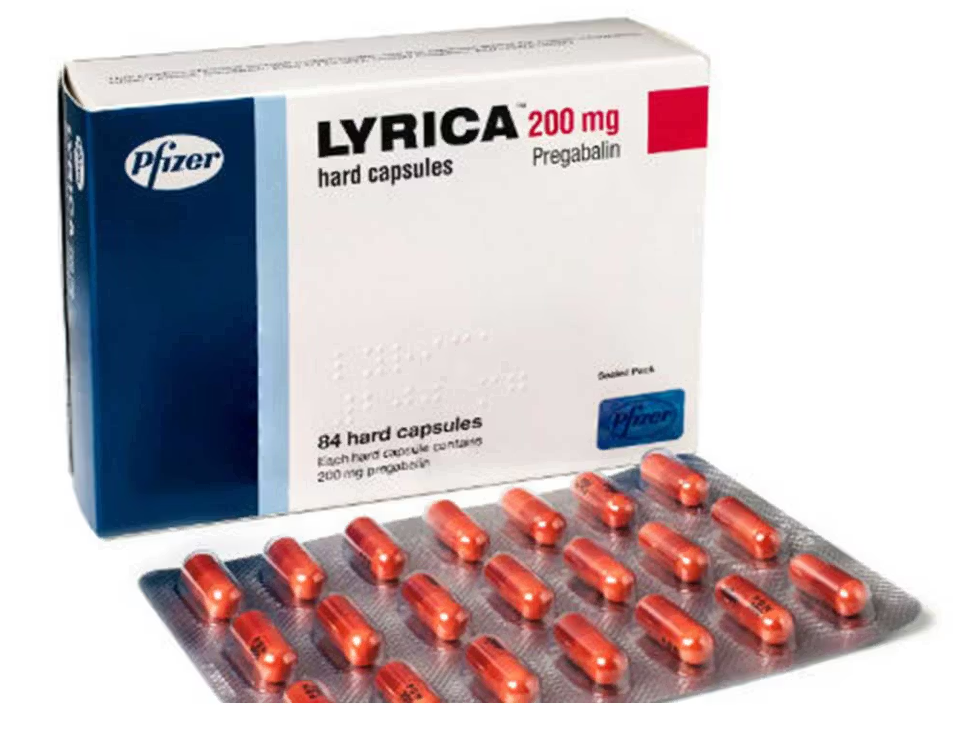
Pregabalin raw materials are typically in powder form, characterized by poor flowability and high hygroscopicity (moisture absorption). Direct compression or capsule filling often encounters challenges such as significant weight variation, capping, and content non-uniformity. Magnesium oxide possesses excellent glidant, anti-adherent, and adsorbent properties. It significantly improves the flowability of the raw powder and reduces inter-particle friction and adhesion. This allows the material to fill die cavities uniformly, ensuring that tablet hardness, weight variation, and capsule fill weight comply with pharmacopoeia standards, thereby increasing production yield and batch-to-batch consistency.
Acting as both a diluent and an absorbent, magnesium oxide can stably carry the active pharmaceutical ingredient (API) of Pregabalin, preventing drug aggregation and ensuring precise dosage control per unit. Its chemical stability ensures no compatibility reactions occur with Pregabalin, which reduces the risk of degradation caused by moisture or oxidation. This enhances the storage stability of the preparation, extends the shelf life, and ensures that the potency and purity of the drug do not decline during long-term storage.
Regarding the in vivo release process, the weakly alkaline nature of magnesium oxide allows it to mildly regulate the pH of the formulation’s micro-environment. This promotes the rapid and uniform dissolution of Pregabalin within the gastrointestinal tract, preventing irritation caused by excessively high local concentrations. Simultaneously, it improves drug absorption efficiency, ensuring rapid onset of action and high bioavailability. For patients prone to gastrointestinal discomfort, the buffering system formed by magnesium oxide during preparation can neutralize gastric acid and protect the gastric mucosa, achieving the dual goals of formulation optimization and improved clinical tolerance.
In conclusion, magnesium oxide is not merely a simple additive in the preparation of Pregabalin; it is a multi-functional excipient that integrates the roles of a glidant, diluent, stabilizer, and absorption regulator. It empowers the entire lifecycle—from powder processing and molding to quality control and in vivo release—ensuring that Pregabalin preparations are safe, stable, and effective. It serves as a quintessential example of the scientific application of excipients in modern pharmaceutical technology.