
Background and Overview [1][2]
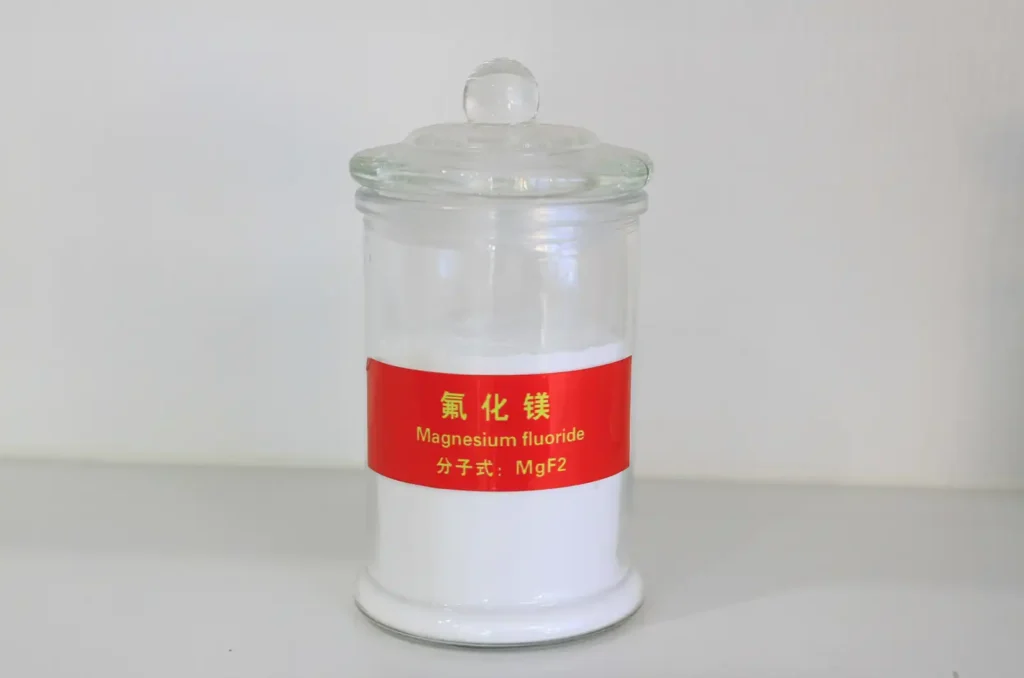
Magnesium fluoride is a colorless tetragonal crystal or white powder, and it is toxic. It is insoluble in water and alcohol but soluble in nitric acid. It is primarily used in the manufacturing of ceramics and glass, as a flux for magnesium and aluminum smelting, as a coating for lenses and filters in optical instruments, as a fluorescent material for cathode ray screens, as an anti-reflective agent for optical lenses, and as a welding flux. Traditional production methods for magnesium fluoride involve the reaction of various magnesium salts with hydrofluoric acid, primarily including the magnesium carbonate method, magnesium oxide method, and magnesium sulfate method.
Traditional methods rely on the reaction between hydrofluoric acid and magnesium salts. Hydrofluoric acid is mainly produced by the reaction of fluorite (fluorspar) with sulfuric acid. The traditional process consumes valuable strategic resources (fluorite). Due to increased national regulation and control over fluorite, its price continues to rise, inevitably driving up the cost of hydrofluoric acid and, consequently, magnesium fluoride. Finding a new fluorine source to replace hydrofluoric acid is an important pathway to reduce production costs and improve the competitiveness of magnesium fluoride. Furthermore, existing processes generate large amounts of mother liquor discharge, which has a significant negative impact on the surrounding environment.
The purity of magnesium fluoride is heavily influenced by the raw magnesium salts used. Magnesium fluoride produced from low-purity magnesium salts (magnesium carbonate, magnesium oxide) typically reaches a main content of only 75%, meeting only the requirements for electrolytic aluminum additives or magnesium smelting fluxes. To meet the requirements for optical lenses and fluorescent materials, high-purity magnesium salts must be used, resulting in a significant price gap between the two grades. Currently, there is an urgent need to find a new type of magnesium salt to solve the issue of high magnesium fluoride prices caused by the high cost of high-purity magnesium salts.
Applications [3]
Magnesium fluoride is widely used in the ceramic and electronic industries, as well as in metallurgy (as a flux), for cathode ray screens (as a phosphor), and as a welding flux. As a colorless, transparent infrared optical material, it possesses a broad transmission range and high transmittance, making it suitable for manufacturing optical prisms, lenses, and window elements in infrared optical systems.
With the widespread military application of infrared technology, optical instruments processed with magnesium fluoride offer, in addition to good light transmission in the mid-wave infrared band, advantages such as high mechanical strength, strong thermal shock resistance, chemical corrosion resistance, and isotropy. It is used in infrared temperature detectors, precision-guided missile fairings, and infrared laser windows.
Since the 1960s, hot-pressed magnesium fluoride has been used in mid-wave infrared guided missiles, aircraft forward-looking infrared (FLIR) windows, infrared pods, and optoelectronic radar systems. Representative missiles include the US “Sidewinder,” Russian missiles, French “Mistral,” and Israeli “Python” missiles. Magnesium fluoride is also used for optical lens coating; applying a film of magnesium fluoride reduces reflections at lens interfaces, diminishes halos, and improves imaging quality.
Preparation Methods [3-5]
1. Magnesium Carbonate Method:
MgCO3+2HF→MgF2+CO2+H2O
This method typically uses dolomite or magnesite as the magnesium source.
Process: 1) Add hydrofluoric acid to the magnesite slurry and stir for a period to obtain magnesium fluoride slurry; treat and vent escaped gases. 2) Filter the slurry, wash and dry the filter residue to obtain the product; use part of the filtrate for slurry preparation and neutralize the rest before discharge.
2. Magnesium Sulfate (or Magnesium Nitrate) Method:
MgSO4+2NaOH→Mg(OH)2+Na2SO4
Mg(OH)2+2HF=MgF2+2H2O
2NaF+MgSO4→Na2SO4+MgF2
Process: 1) Pre-treat the hydrated magnesium sulfate to remove impurities. 2) React magnesium sulfate with a base; wash and filter the intermediate, then react it with excess hydrofluoric acid in a lead-lined or plastic-lined reactor under a specific carbon dioxide partial pressure. 3) Wash, dry, and pulverize the material to obtain high-purity magnesium fluoride.
3. Magnesium Oxide Method:
2HF+MgO→MgF2+H2O
Process: 1) Place high-purity (99.99%) magnesium oxide in a platinum crucible and react it with 40% analytical-grade hydrofluoric acid to form a magnesium fluoride slurry. 2) Refine, filter, dry, and pulverize the slurry to obtain high-purity magnesium fluoride.
4. Magnesium Chloride Method:
MgCl2+2NH3+2H2O→Mg(OH)2+2NH4Cl
Mg(OH)2+2HF→MgF2+2H2O
Brine-Ammonia-Hydrofluoric Acid Method: 1) Prepare brine from MgCl₂, pass ammonia gas to precipitate Mg(OH)₂, filter, and pulverize the filter cake. 2) Add slightly excess hydrofluoric acid to the cake, then filter, wash to remove adsorbed HF, and dry to obtain the product.
2NH4F+MgCl2→MgF2+2NH4Cl
Ammonium Fluoride-Magnesium Chloride Method: 1) React ammonium fluoride solution (30–45%) with magnesium chloride solution (25–36%) to form a slurry, then filter to obtain a paste. 2) Wash with hot water (60–70°C), dry at 250–400°C for 1–2 hours, and pulverize.
5. Basic Magnesium Carbonate Method:
4MgCO3⋅Mg(OH)2⋅H2O+CO2→Mg(HCO3)2+H2O
Mg(HCO3)2+HF→MgF2+CO2↑+H2O
This method transforms basic magnesium carbonate into pure magnesium fluoride through carbonization. By establishing an equilibrium between unstable magnesium dicarbonate and magnesium carbonate hydrates, the solubility of particles is increased. Upon reaction with slightly excess HF in a sealed reactor under stirring, fine magnesium fluoride particles are precipitated. After washing, neutralizing with NH₄OH, drying, and calcining, a uniform, high-purity powder suitable for optical coating is obtained.
6. Liquid-Phase Neutralization Method:
MgRx+2NH4OH→Mg(OH)2↓+2NH4Rx/2
Mg(OH)2+HF→MgF2+H2O
This method uses soluble magnesium salts as the main raw material, reacting them with ammonia to form magnesium hydroxide, which then reacts with hydrofluoric acid.
Steps: ① Prepare a uniform soluble magnesium salt solution; ② Introduce ammonia to precipitate Mg(OH)₂; ③ Filter and wash to neutralize; ④ React with hydrofluoric acid, then filter, wash, and dry.
Advantages: This method allows for easier removal of impurities, resulting in high purity (up to 99.91% using brine-derived MgCl₂). Due to the lower impurity content of magnesium chloride and the larger particle size of magnesium hydroxide, this process is cost-effective and holds high industrial value. The purity of the final product is primarily dependent on the purity of the raw magnesium salt.