
Introduction
Magnesium Hydroxide is an environmentally friendly green inorganic flame retardant that offers excellent flame retardancy, smoke suppression, and filling effects. It possesses a high decomposition temperature and does not produce toxic or harmful pollutants during decomposition. Furthermore, Magnesium Hydroxide can be used synergistically with other flame retardants to achieve enhanced performance.
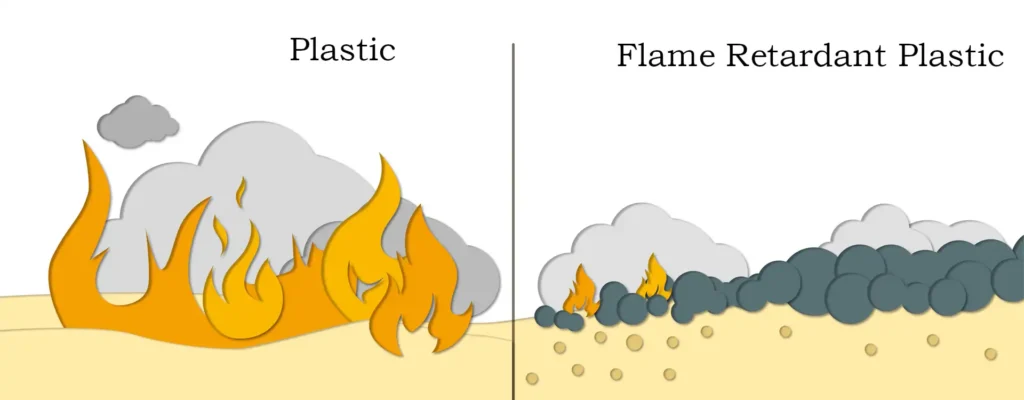
Application of Magnesium Hydroxide Flame Retardants in Polypropylene (PP)
PP is characterized by low toxicity, low cost, excellent electrical insulation, good processability, and chemical corrosion resistance, meeting the requirements for applications in sectors such as automotive and construction. However, PP is highly flammable, burns rapidly, produces molten droplets, and releases significant amounts of toxic smoke; therefore, improving its thermal and flame resistance is critical. Researchers such as Chen Lingzhi used magnesium sulfate, ammonia, and activated carbon as raw materials to prepare an activated carbon-modified Magnesium Hydroxide flame retardant for use in PP polymers. Results showed that by applying the modified Magnesium Hydroxide to PP, the Limiting Oxygen Index (LOI) increased from 19.6% to 28.9%, significantly improving its flame retardant performance.
Application of Magnesium Hydroxide Flame Retardants in Polystyrene (PS)
PS is widely used in construction, decoration, electronics, and transportation due to its low price, easy processing, corrosion resistance, high impact strength, and durability. However, PS has a low LOI value, is easily combustible, continues to burn after the ignition source is removed, and releases a large amount of heat and toxic smoke while producing severe molten droplets. Researchers added Magnesium Hydroxide to PS to study the changes in flame retardancy. The results indicated that as the amount of Magnesium Hydroxide increased, the CO2 produced during thermal degradation decreased steadily, while char residue rose sharply. The content of volatiles and semi-volatiles also increased, indicating that the addition of Magnesium Hydroxide changed the flame retardancy of PS, increased its combustion temperature, and altered its combustion mechanism.
Application of Magnesium Hydroxide Flame Retardants in Polyvinyl Chloride (PVC)
PVC is a common general-purpose thermoplastic used in films, pipes, wall panels, and electrical materials (especially cable insulation). It is categorized into rigid PVC and soft PVC. Rigid PVC, which contains fewer plasticizers, has better flame retardancy than soft PVC. However, PVC contains chlorine, which releases hydrogen chloride gas and a large amount of toxic smoke upon combustion. Therefore, when improving the flame retardancy of PVC, smoke suppression is a vital concern.
Magnesium Hydroxide flame retardants can improve the flame retardancy of PVC while reducing toxic emissions. Wu Jianning and others used different modifiers for the surface modification of Magnesium Hydroxide and studied its effects on the mechanical properties and flame retardancy of PVC. The results showed that zinc stearate was the most effective modifier, resulting in an oil absorption value of 33.39%. The resulting Magnesium Hydroxide particles were uniformly dispersed with significantly reduced agglomeration. While this markedly improved the flame retardancy of PVC, it did have some impact on its tensile strength.
Application of Magnesium Hydroxide Flame Retardants in Polyethylene (PE)
PE is widely used in construction, electrical, and medical industries due to its excellent processability, electrical insulation, mechanical properties, and resistance to high and low temperatures. However, its LOI value is only about 17.4%, making it highly flammable. Common flame retardants for PE include halogen-based, phosphorus-nitrogen-based, and inorganic retardants like aluminum/magnesium. Magnesium Hydroxide is particularly favored due to its low cost and environmental friendliness.
Tao Jun studied PE composites using three different particle sizes of Magnesium Hydroxide as flame retardants. The results showed that Magnesium Hydroxide significantly improved the flame retardancy and thermal stability of PE. When the Magnesium Hydroxide particle size was 3.1 μm, the composite achieved the best comprehensive performance: a tensile strength of 16.1 MPa, elongation at break of 400%, an LOI of 22.3%, a Peak Heat Release Rate (PHRR) of 270 kW/m2, and a volume resistivity of 5.2×10¹³Ω⋅m
Challenges and Outlook for Magnesium Hydroxide Flame Retardants
Although Magnesium Hydroxide is a green, eco-friendly, and cost-effective material widely used in the plastics industry, it faces challenges. Because Magnesium Hydroxide is an additive-type flame retardant, a high loading is required to meet stringent flame retardant standards. Additionally, Magnesium Hydroxide is highly polar and hydrophilic, making it difficult to disperse in polymers. This leads to agglomeration, poor compatibility with plastics, decreased strength of the composite, and worsened processability and flowability, which limits its large-scale application.
Future research should focus on the ultrafine processing of Magnesium Hydroxide, the development of new surface modifiers, compounding with other flame retardants, and microencapsulation technology. These efforts aim to enhance the flame retardant efficiency of Magnesium Hydroxide while improving its compatibility with plastics and minimizing its impact on mechanical properties, thereby expanding the application of Magnesium Hydroxide in the field of plastic flame retardancy.