
In the process of noodle production, preventing sticking is a critical stage. Whether it is dried noodles, ramen, or pasta, preventing them from adhering to each other during drying, storage, and transportation is key to ensuring product appearance, texture, and commercial value. Food-grade magnesium carbonate plays an indispensable role in this regard. In this specialized field, the food-grade magnesium carbonate produced by Hebei Messi Biology Co., Ltd. has become the preferred raw material for many well-known food enterprises, thanks to its exquisite craftsmanship and stringent quality standards.
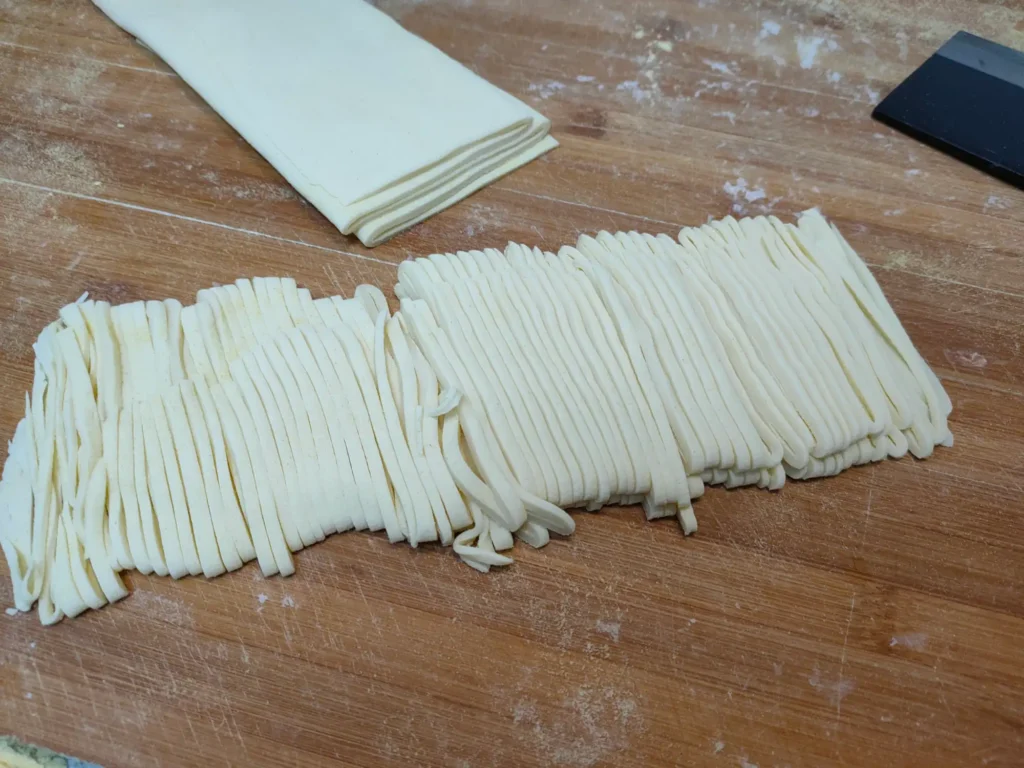
I. Scientific Principles: Why is Magnesium Carbonate Effective?
To understand the advantages of Messi Biology’s magnesium carbonate, one must first grasp the basic principles of its action. The main components of noodles are starch and protein (gluten). During drying or storage, starch molecules on the surface of the noodles tend to recombine through intermolecular forces such as hydrogen bonding. Coupled with environmental humidity, this easily leads to noodles sticking together or clumping, which affects cooking and consumption.
The anti-sticking efficacy of magnesium carbonate stems from two core mechanisms:
- Superior Physical Isolation: Magnesium carbonate is a white powder with unique properties, characterized by ultra-fine particle size, light specific gravity, and strong adsorption capabilities. When a trace amount is evenly applied to the surface of the noodles, billions of tiny particles act as “efficient miniature ball bearings.” They construct a fine, smooth physical barrier between individual noodles. This layer effectively prevents direct contact between noodle surfaces, fundamentally eliminating the physical conditions that lead to sticking.
- Efficient Moisture Regulation: Moisture is the primary culprit behind starch gelatinization and sticking. Food-grade magnesium carbonate possesses a natural, mild hygroscopicity (moisture absorption). It actively adsorbs excess moisture exuded from the surface of the noodles, maintaining the interface in an appropriately dry state. Through precise humidity control, it disrupts the environment where starch molecules bond via “water bridging,” thereby achieving long-term anti-sticking effects.
II. Beyond Standards: Core Advantages of “Messi Biology” Food-Grade Magnesium Carbonate
Advantage 1: Extreme Purity and Absolute Safety Assurance
Hebei Messi Biology Co., Ltd. utilizes advanced production processes and refining technologies. Its food-grade magnesium carbonate is of extremely high purity and strictly adheres to the National Food Safety Standard for Food Additives (GB 2760). The content of harmful impurities such as heavy metals and arsenic is far below the national limit, ensuring the absolute safety of the final food product. For brand owners, choosing Messi Biology means fulfilling a commitment to consumer health and effectively avoiding food safety risks associated with raw material impurities.
Advantage 2: Precisely Controlled Ultra-Fine Particle Size and Superior Performance
The anti-sticking effect is closely related to particle size. Particles that are too coarse affect the mouthfeel and easily fall off, while those that are too fine may lose their “ball bearing” effect. Messi Biology employs advanced grinding and classification technology to precisely control the particle size distribution, maintaining it within the optimal range for anti-caking. This ultra-fine, uniform powder has a larger specific surface area, maximizing its adsorption and coverage efficiency. A trace addition can form a uniform and dense protective layer, providing significant anti-sticking results while minimizing the impact on the original taste and texture of the noodles.
Advantage 3: Excellent Stability and Compatibility
The magnesium carbonate from Messi Biology is chemically stable and does not easily react with other components in noodles (such as proteins or fats). It does not cause discoloration, off-flavors, or deterioration. This means that after addition, the noodles maintain stable quality and excellent dispersibility throughout their shelf life. Whether in high-temperature, high-humidity summers or dry winters, it provides reliable anti-sticking protection, significantly reducing the loss rate for enterprises.
Advantage 4: Professional Technical Support and Customized Services
As a technology-driven magnesium salt company deeply rooted in the industry, Messi Biology provides more than just high-quality products; it offers robust technical support and application solutions. They can provide personalized product usage suggestions and formulation plans based on the customer’s specific production processes and noodle types (such as high-gluten noodles, buckwheat noodles, or rice noodles), helping customers optimize their processes and maximize benefits while remaining compliant with regulations.
Conclusion
Food-grade magnesium carbonate is an ingenious and efficient solution in modern noodle production. By pursuing perfection in purity, particle size, and safety, Messi Biology has brought new value to this traditional additive. It provides the food industry with a safer, more efficient, and more reliable choice, serving as a powerful boost for brand owners looking to enhance product quality and win consumer trust.