
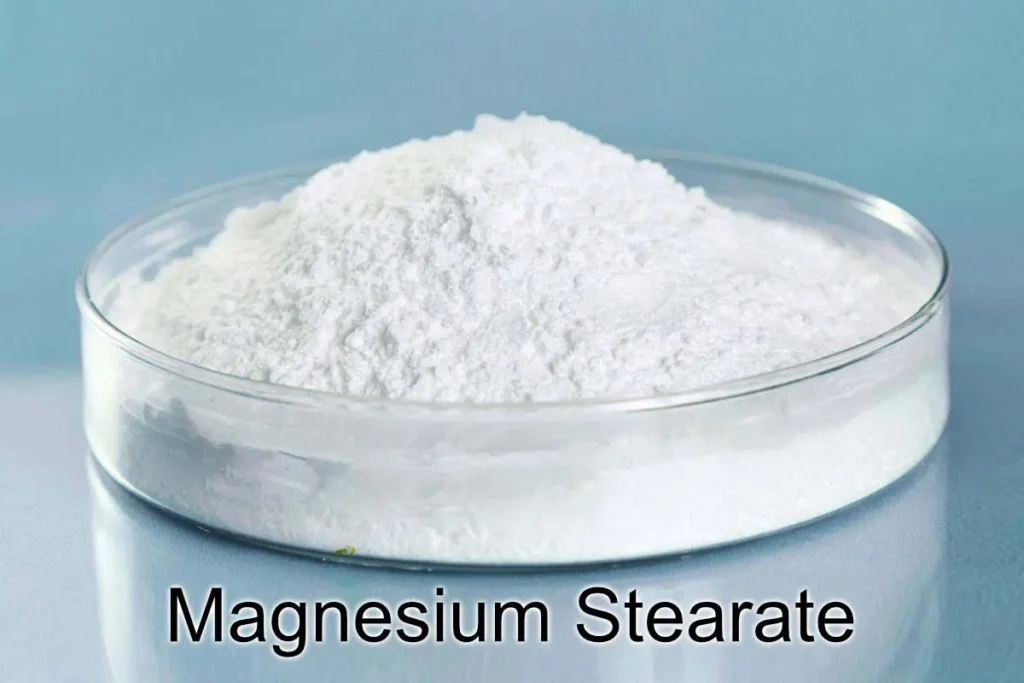
Magnesium stearate is an organic compound widely used in the food, pharmaceutical, cosmetic, and industrial sectors. Its chemical formula is Mg(C₁₈H₃₅O₂)₂. It usually appears as a fine, white, grit-free powder with a greasy touch. It is insoluble in water, ethanol, and ether, but soluble in hot water and hot ethanol. Below is a detailed overview across several dimensions:
1. Basic Properties
Physical Properties
- Appearance: Fine, white, grit-free powder with a slight characteristic odor.
- Touch: Feels greasy when in contact with the skin.
- Solubility: Insoluble in water, ethanol, and ether; soluble in hot water and hot ethanol.
- Melting Point: Approximately 88.5°C (may vary slightly depending on the source).
- Density: Approximately 1.07 g/cm³.
Chemical Properties
- Decomposes into stearic acid and corresponding magnesium salts when exposed to strong acids.
- Hygroscopic, yet chemically stable; does not undergo self-polymerization.
2. Manufacturing Process
Magnesium stearate is usually produced via chemical synthesis. The main steps include:
- Reacting stearic acid with magnesium hydroxide under appropriate conditions.
- Controlling the reaction temperature and pH level to ensure the purity and quality of the product.
- Obtaining the final product through filtration, washing, drying, and other steps.
Additionally, with technological advances, new synthesis methods—such as ultrasound-assisted synthesis—have been proposed. These novel methods hold promise for improving production efficiency and lowering costs.
3. Application Fields
Food Industry
- Used as an emulsifier, anti-caking agent, and coating agent in foods such as candies, preserved fruits, pastries, chewing gum, and select dairy products.
- Prevents food ingredients from sticking together, ensuring product uniformity and stability.
- Enhances food texture and mouthfeel, such as making chocolate smoother and glossier.
Cosmetics Industry
- Applied in powder cosmetics like foundation and eyeshadow to increase product viscosity and lubricity.
- Improves the spreadability and application feel of cosmetics, enhancing the user experience.
Industrial Sector
- Serves as a stabilizer and lubricant for polyvinyl chloride (PVC), used alongside calcium and zinc soaps in non-toxic products.
- Acts as a catalyst and matting agent in paints to improve paint performance and appearance.
- Used as a filter aid, clarifying agent, defoamer, as well as a suspending agent and thickener in liquid formulations.
Market Outlook: With growing global demand for healthy foods, magnesium stearate faces broad market prospects. Meanwhile, technological progress and refined manufacturing techniques are expected to reduce production costs, further driving its application in emerging markets. In addition, developing new types of functional magnesium stearate products will become a major trend in the industry’s growth.