
According to Messi Biology, the core of achieving transparency in transparent ceramics lies in eliminating internal pores and achieving dense and uniform grain structures. Magnesium oxide (MgO) belongs to the cubic crystal system, is optically isotropic, and is free from grain-boundary birefringence, making it a natural base material for transparent ceramics. With a high melting point of up to 2852°C and stable chemical properties, high-purity magnesium oxide can be used as a raw material through processes such as vacuum sintering and hot-pressing sintering to prepare MgO transparent ceramics with a relative density close to the theoretical value. Its light transmittance in the mid-infrared band reaches 80%–85%, and its comprehensive performance far surpasses that of traditional alumina transparent ceramics.
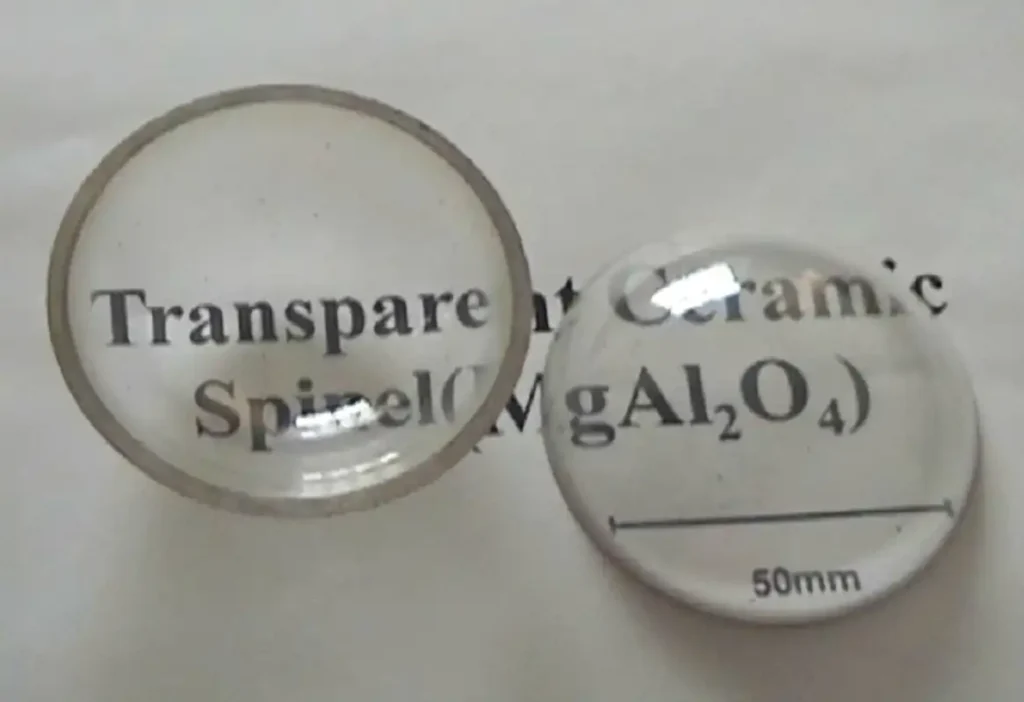
As a primary material, magnesium oxide can be directly sintered into MgO transparent ceramics, offering advantages such as high infrared transmittance, high insulation, and resistance to alkali metal corrosion, making it a key material for high-temperature infrared windows, missile radomes (nose cones), and high-pressure sodium lamp arc tubes. As an additive, magnesium oxide can effectively inhibit the excessive grain growth of transparent ceramics such as alumina and YAG, promote the complete discharge of pores, and enhance both density and light transmittance.
The performance advantages of MgO transparent ceramics are exceptionally prominent. In terms of high-temperature resistance, they can withstand long-term temperatures up to 1800°C with a thermal shrinkage rate of less than 5%, which is vastly superior to glass and ordinary ceramics. Optically, they feature a broad infrared transmission band and low optical loss, meeting the high-precision demands of laser devices and infrared detectors. Mechanically, they boast a flexural strength of up to 134 MPa and strong thermal shock resistance, enabling them to endure sudden temperature changes in extreme environments. In addition, high-purity magnesium oxide is non-toxic and possesses excellent chemical stability, aligning with the demands of high-end equipment and green manufacturing.