
Messi Biology states that the core advantage of magnesium oxide’s (MgO) sound insulation performance in building materials lies in the sound-absorption capacity brought by its natural microporous structure. However, the actual sound insulation volume (transmission loss) is ultimately determined by a combined design of board thickness, cavity construction, and supporting sound-absorbing materials.
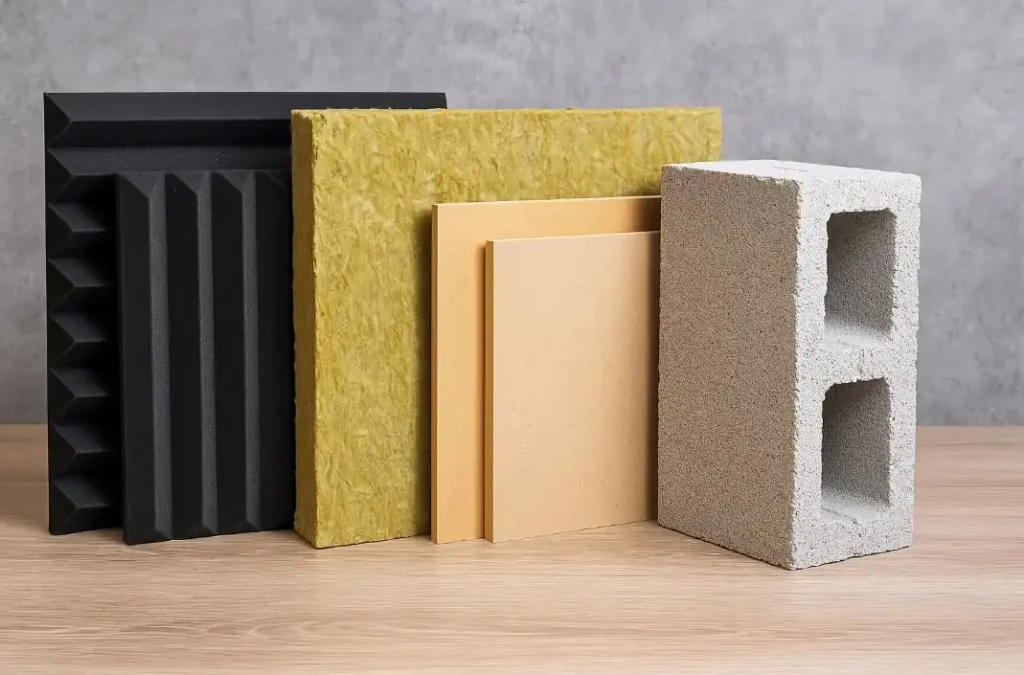
The microporous structure is the secret weapon of magnesium oxide’s sound insulation. Glass-magnesium boards (MgO boards) use active magnesium oxide and magnesium salt solutions as gelling bases, supplemented with glass fiber cloth and plant fibers for reinforcement. After curing, a large number of uniform, tiny, and interconnected pores are formed inside. When sound waves enter the interior of the material along these pores, they repeatedly friction and vibrate against the pore walls, gradually converting acoustic energy into thermal energy and dissipating it—this is the classic mechanism of sound absorption in porous materials. At the same time, the board itself has a certain surface density, which can block part of the transmission of airborne sound. Thus, both “absorption” and “isolation” mechanisms are achieved in magnesium oxide boards.
Perforated boards are an extension of magnesium oxide in the direction of sound absorption. By mechanically or laser-drilling holes into the flat board, backed with sound-absorbing non-woven fabric or acoustic wool, a Helmholtz resonance cavity is formed with the wall surface, providing targeted absorption for mid-to-low-frequency noise. These products are widely used in public spaces with strict requirements on reverberation time, such as mechanical equipment rooms, subway stations, gymnasiums, and broadcasting stations. Compared with similar materials, magnesium oxide boards possess their own differentiated advantages. At the same thickness, their sound insulation performance is slightly better than that of ordinary gypsum boards, while also featuring Grade A1 non-combustibility, water and moisture resistance, and being asbestos-free and formaldehyde-free. This makes them particularly suitable for sound insulation structures in damp areas such as kitchens, bathrooms, and basements. Modified magnesium sulfate and magnesium oxychloride cement-based boards have higher densities, with sound insulation volumes reaching 45–55 dB, approaching the levels of brick walls of the same thickness.
It is necessary to view its applicable boundaries objectively. Magnesium oxide boards have a density of only 0.8–1.2 g/cm³, which is much lower than that of bricks and concrete. According to the “mass law” of sound insulation, insufficient surface density inevitably limits the upper limit of single-board sound insulation. To achieve ideal results, the combination of a cavity, acoustic wool, and double-sided paneling is almost indispensable. Low-frequency sound insulation is also a common shortcoming of thin boards; when necessary, the board thickness must be increased or a double-layer staggered installation method should be adopted.
Overall, magnesium oxide building materials are well-suited to act as the “panel champion” in lightweight sound insulation systems—their solo performance capacity is limited, but when scientifically “teamed up” with keels, rock wool, and sound-absorbing cotton, they can completely create sound insulation effects comparable to traditional heavy walls without increasing building loads, perfectly aligning with the current development direction of prefabricated buildings and green building materials.