
Research Background
Magnesium is one of the four essential macro-elements for the human body, participating in almost all metabolic processes. Magnesium in the human body primarily exists in the bones and organs, playing a vital role particularly in the heart, kidneys, and muscle tissues. Currently, magnesium supplements used in daily life are mainly inorganic magnesium salts such as magnesium sulfate; however, these generally suffer from low bioavailability and significant side effects. Magnesium citrate is an important source of magnesium nutrition with a magnesium content of up to 11%. It is easily absorbed by the human body. It appears as white granules or crystalline powder, is soluble in dilute acid, and is slightly soluble in water and alcohol [1].
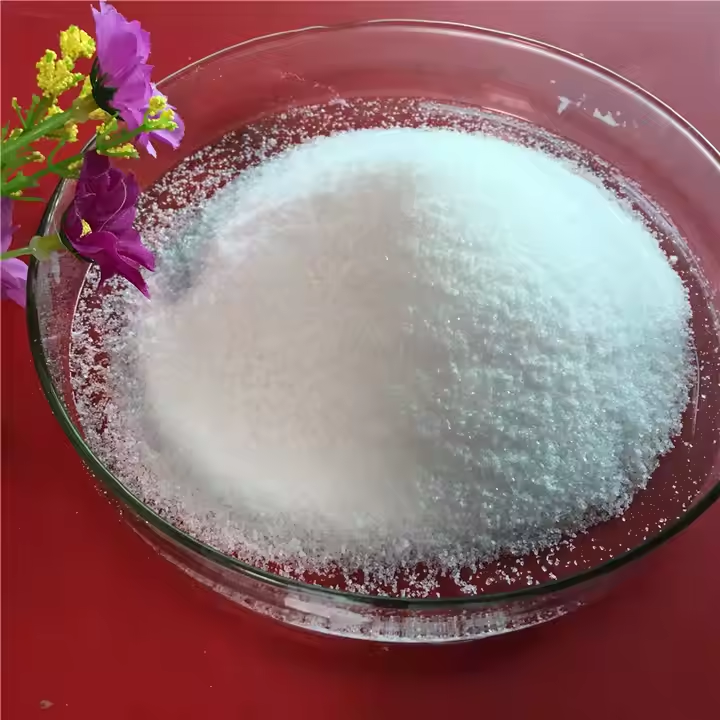
(Figure: Physical properties of Magnesium Citrate)
Application
Medical Use: Magnesium citrate can be used as a medication, most commonly as a saline laxative [2]. It is used before surgeries to help patients clear their bowels.
Health Food: It has significant applications in health food technology. For example, it is used to synthesize a compound magnesium pressed candy for the prevention of stones (calculi). This candy consists of raw materials and excipients, where the raw materials include the following by weight percentage: magnesium carbonate 8-50%, magnesium citrate 3-15%, magnesium glycinate 3-10%, magnesium orotate 2-5%, taurine 8-15%, Vitamin C 0-15%, inositol 0-15%, and trehalose 18-22%. By compounding magnesium salts with taurine and trehalose, this candy not only provides basic nutrition but also reduces the risk of stones, offering an excellent preventive effect [2].
Agriculture: Literature also reports a weight-reducing and efficiency-enhancing water-soluble fertilizer and its preparation method. It is prepared from the following raw materials (by weight): 13-19 parts phosphoric acid, 26-32 parts urea, 41-47 parts potassium nitrate, 3-5 parts calcium chloride, 2-4 parts amino acids, 2-4 parts humic acid, 0.3-0.5 parts magnesium citrate, 0.4-0.6 parts borax, and 0.08-0.12 parts ferrous sulfate. This fertilizer is highly water-soluble and suitable for fertigation, drip irrigation, and root watering. It promotes strong roots and seedlings, improves crop quality, and is rich in nutrients like humic and amino acids, which effectively repair farmland with continuous cropping obstacles, improve soil fertility, and promote crop growth [3].
Electrochemistry: In the field of electrochemical research, a high-performance porous carbon electrode material can be prepared using glucose as a precursor and magnesium citrate as a template, followed by pre-carbonization and KOH activation. Scanning electron microscopy (SEM) studies of the samples before and after doping with magnesium citrate showed that the activated carbon prepared via the magnesium citrate template method has a more uniform pore size distribution. Nitrogen adsorption-desorption tests revealed that using magnesium citrate as a template increased the specific surface area of the activated carbon from 135.6 m2/g to 326.13 m2/g. Electrochemical tests showed that the electric double-layer capacitance characteristics were significantly improved. At a current density of 0.5 A/g, the specific capacitance of AC-Mg (139.88 F/g) was much higher than that of standard AC (31 F/g). At a current density of 10 A/g, the capacitance retention of AC-Mg increased to 87% (compared to 72.5% for AC). The resistance of the electrode material decreased from 1.589 Ω to 1.021 Ω, indicating better conductivity. After 5,000 cycles, the AC-Mg capacitance retention remained at 96% [4].
(Figure: SEM image of the surface morphology of AC-Mg electrode material)
Synthesis Processes
Currently, in industry, magnesium citrate is produced by reacting magnesium carbonate, magnesium oxide, or magnesium hydroxide with food-grade citric acid. The standard method involves dissolving citric acid in water, filtering it, and heating it to 70°C. Then, a slurry of the magnesium source is added. Often, the flow rate of the slurry is uncontrolled, but the pH is maintained between 5 and 8. After crystallization, washing, and drying, the product is screened for particle size. However, simply controlling the pH between 5 and 8 often results in the final crystals being contaminated with reactants, leading to lower purity [1]. Therefore, developing new high-efficiency synthesis processes is of great significance.
Method 1:
Citric acid solution (concentration 10%–20% by mass) is added to the magnesium source, followed by an ultrasonic-microwave coupling reaction. This method achieves rapid preparation, reducing the entrapment of reactants and improving purity. The ultrasound accelerates the dissolution of the magnesium source, while the microwave provides uniform and rapid heating, ensuring reaction homogeneity and high purity during crystallization [5].
Method 2:
Magnesium citrate is produced by reacting magnesium carbonate, oxide, or hydroxide with food-grade citric acid, followed by cooling, crystallization, washing with hot deionized water, and drying. The final product can be granular or powder form, and its quality meets or exceeds the USP30/NF25 standards [6].
Related Research
A clinical study was conducted to explore the effects of magnesium citrate solution combined with Compound Polyethylene Glycol (PEG) Electrolyte Powder for bowel preparation before colonoscopy. Researchers divided 106 patients into a study group (54 cases) and a control group (52 cases). The study group used the combination of magnesium citrate and PEG, while the control group used PEG alone.
Results:
There was no statistically significant difference (P>0.05) between the two groups regarding lesion detection rate, insertion time, or post-medication electrolyte and liver/kidney functions. However, the study group (magnesium citrate + PEG) showed:
- Higher total effectiveness in bowel preparation quality: 96.3% vs. 82.7%.
- Shorter time to first bowel movement: (32.5 ± 26.1) min vs. (47.2 ± 22.4) min.
- More frequent bowel movements: (8.2 ± 2.9) times vs. (6.2 ± 2.6) times.
- Lower incidence of nausea: 22.2% vs. 48.1%.
All these differences were statistically significant (P<0.05P < 0.05P<0.05). There were no significant differences in the incidence of vomiting, bloating, or abdominal pain.
Conclusion:
The application of magnesium citrate combined with Compound Polyethylene Glycol Electrolyte Powder for preoperative bowel preparation in colonoscopy can improve the quality of the preparation and reduce the occurrence of complications [7].