
Messi Biology states that magnesium carbonate plays a triple key role in the preparation of doped gadolinium gallium garnet (SGGG) crystals: it serves as an efficient carrier of magnesium ions, an active initiator for the synthesis of polycrystalline material, and an “invisible regulator” of crystal quality. Without this seemingly ordinary chemical raw material, the difficulty of mass-producing high-performance magneto-optical substrates would increase exponentially.
I. What is an SGGG Crystal and Why Does It Need “Doping”?
The full name of SGGG is Substituted Gadolinium Gallium Garnet, a new type of garnet single crystal formed on the Gd₃Ga₅O₁₂(GGG) skeleton by partially substituting Gd³⁺ with Ca²⁺ and partially substituting Ga³⁺ with Mg²⁺ and Zr⁴⁺. Its downstream application scenarios are highly focused: serving as substrates for liquid phase epitaxy (LPE) thin films of yttrium iron garnet (YIG) and bismuth iron garnet (BIG), it is widely used in optical communication isolators, magnetic bubble memory, magnetic refrigeration, and quantum magnonic devices. The challenge is that pure GGG has a lattice constant of about 12.383 Å, which exhibits a noticeable mismatch with high-bismuth-substituted iron garnet thin films, making it prone to stress cracks and high misfit dislocations during epitaxy. Through the synergistic substitution of Ca/Mg/Zr, the lattice constant of SGGG can be finely tuned within the range of 12.40–12.54 Å, thereby achieving near-zero mismatch with RIG thin films of different compositions. And in this “recipe,” the source of magnesium is usually not magnesium oxide, but magnesium carbonate—which is precisely what makes it special.
II. The “Decompose First, Activate Later” Characteristic of Magnesium Carbonate
The chemical formula of magnesium carbonate is MgCO₃. It begins decarboxylating at around 350°C and completely decomposes into magnesium oxide and carbon dioxide at around 700°C—this reaction pathway is precisely why it outperforms the direct use of MgO. In the solid-state synthesis of SGGG polycrystalline material, after high-purity magnesium carbonate is batched together with raw materials such as Gd₂O₃, Ga₂O₃, ZrO₂, and CaCO₃ and heated, magnesium carbonate first undergoes a two-step “decomposition—activation” process: the released CO₂ forms transient channels inside the powder, facilitating the discharge of adsorbates and avoiding local agglomeration; the newly generated MgO has an underdeveloped crystal lattice, dense defects, and a large specific surface area, resulting in chemical reactivity far higher than that of ordinary calcined magnesium oxide, enabling it to diffuse more rapidly and uniformly into the garnet precursor lattice to participate in the phase-formation reaction. This “decompose first, activate later” pathway achieves a more uniform distribution of Mg²⁺ in the solid-state charge, preventing compositional segregation caused by magnesium enrichment from the source.
III. Triple Effects After Mg2+Mg2+ Enters the Crystal Lattice
Once the Mg²⁺ released by magnesium carbonate truly enters the SGGG crystal lattice, its effects are primarily manifested in three aspects.
First is the fine tuning of the lattice constant. The ionic radius of Mg²⁺ is smaller than that of Ga³⁺; after entering the octahedral sites, it causes local unit cell contraction, whereas the larger radius of Zr⁴⁺ expands the lattice. Pairing the two enables precise regulation of the lattice constant within a linear range, bringing the mismatch rate between SGGG and YIG/BIG thin films close to zero.
Second is the optimization of melt behavior. A small amount of Mg²⁺ entering the GGG melt can improve the melt’s supercooling behavior, suppressing abnormal morphologies such as facet growth and spiral growth, and making the Czochralski pulling growth process smoother. Early patent studies indicate that adding 15–100 ppm of magnesium ions (introduced in the form of magnesium carbonate, magnesium oxide, etc.) to the GGG melt can significantly suppress the generation of edge dislocations and noticeably increase the yield of large-size single crystals; however, excessive addition can cause crystal coloration, so the doping amount of magnesium carbonate must be strictly controlled.
Third is the macroscopic improvement of crystal quality. Actual growth data show that for Ca/Mg/Zr:GGG crystals using magnesium carbonate as the magnesium source, the full width at half maximum (FWHM) of the X-ray rocking curve can be as low as 0.33′, the dislocation density can be controlled at the order of tens to hundreds per square centimeter, and the transmittance in the visible-to-infrared band remains above 80%, fully meeting the industrial requirements for magneto-optical substrates.
IV. Horizontal Comparison with Other Magnesium Sources
① First, consider magnesium carbonate. Its activation method is the most unique—relying on high-temperature decomposition to release highly reactive magnesium oxide, while the carbon dioxide generated during decomposition also creates pores inside the powder to prevent raw material agglomeration, resulting in optimal distribution uniformity of magnesium in the polycrystalline charge. Its effect on the melt is suppressing abnormal growth, though the doping amount must be controlled within the 15–100 ppm range. Overall, it possesses the widest process window and the highest tolerance for minor fluctuations during batching and heating.
② Next, consider the direct doping of magnesium oxide. Because there is no pre-decomposition process, magnesium can only rely on high-temperature diffusion to enter the precursor, leading to poorer distribution uniformity and susceptibility to local agglomeration and segregation. Reflected in the melt, this easily produces optical defects such as color centers due to magnesium enrichment. Therefore, its process window is the narrowest, placing the most stringent demands on operational precision.
③ Finally, there is magnesium nitrate. It likewise achieves activation through decomposition with good activation effects, yet the decomposition process releases large amounts of nitrogen oxide gases, and residual gas may introduce pores into the crystal. Its distribution uniformity lies between the first two, and its process window is also relatively narrow.
A comprehensive comparison shows that magnesium carbonate strikes the optimal balance among activation pathway, distribution uniformity, and process tolerance, which is the fundamental reason it holds a dominant position in industrial-grade SGGG formulations.
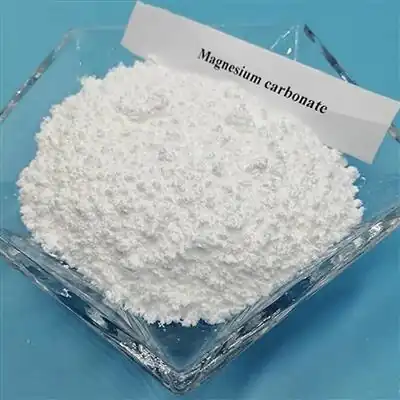
From a white powder to a piece of high-end magneto-optical substrate, magnesium carbonate undergoes a complete journey of “decomposition—activation—lattice entry—synergistic regulation.” It neither emits light itself nor directly generates magneto-optical effects, yet through the mainline of providing highly active Mg²⁺, it determines the lattice matching precision, dislocation density, and optical uniformity of SGGG crystals. Understanding the role of magnesium carbonate in SGGG means understanding that process logic in the modern magneto-optical material industrial chain where “the supporting role determines success or failure.”