
Messi Biology states that in high-end manufacturing sectors such as aerospace and electronic communications, structural ceramics have become core materials due to their high-temperature resistance and corrosion resistance. Magnesium oxide (MgO), a common inorganic compound, is playing an irreplaceable role in structural ceramics with its unique advantages, appearing in everything from rocket nozzles to 5G base stations.
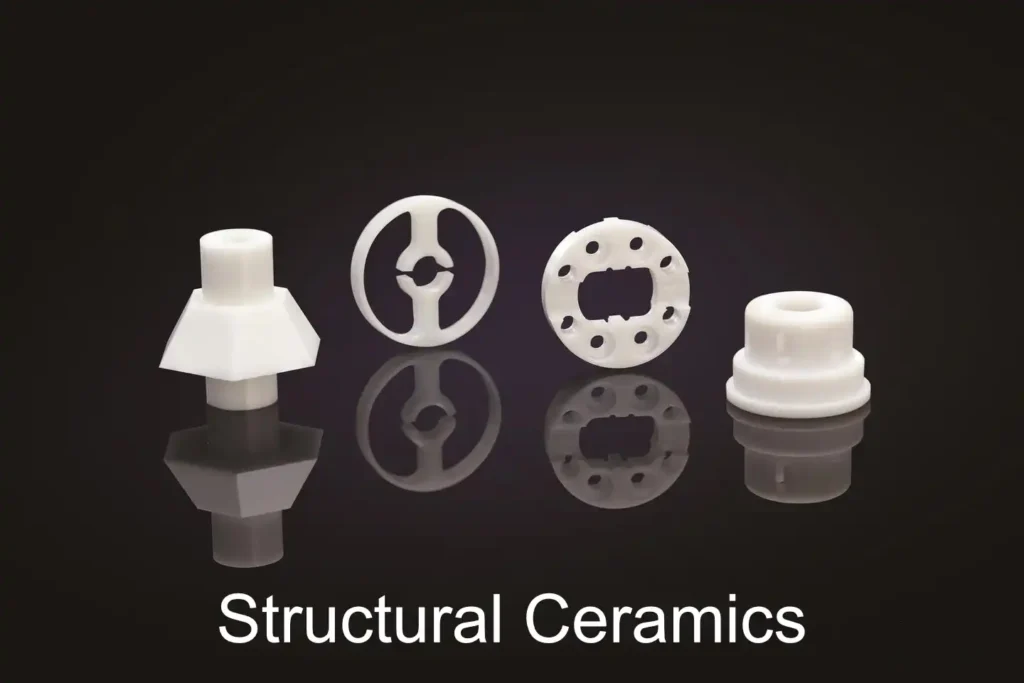
The reason magnesium oxide has become an ideal raw material for structural ceramics lies in its “hardcore” characteristics: it has a melting point as high as 2852°C and can maintain structural stability at temperatures above 2000°C; it has a Mohs hardness of 6, providing significant mechanical strength; and its electrical resistivity at room temperature exceeds 10¹⁴ Ω·cm, offering excellent insulation. These properties allow it to be sintered into ceramics individually or used as a functional additive to enhance the performance of other ceramics.
In the field of high-temperature structures, magnesium oxide ceramics act as “guardians” of extreme environments. High-purity MgO crucibles can stably contain molten alumina at 2050°C, providing a pure environment for the growth of sapphire single crystals used in LED substrates. In the aerospace sector, magnesium oxide-based composite materials are used as liners for rocket engine nozzles, capable of withstanding the erosion of high-temperature gas exceeding 3000°C while providing thermal protection through low thermal conductivity. In the nuclear industry, it serves as a critical crucible material for smelting high-purity uranium and thorium, ensuring a metal purity of 99.99% thanks to its chemical inertness.
In the field of electronic information, magnesium oxide ceramics have become the “cornerstone” of high-end devices. Magnesium oxide ceramic substrates produced via tape casting feature a dielectric loss as low as 1.2×10⁻⁶ and a thermal conductivity of 30 W/(m·K). These can be directly integrated with GaN (Gallium Nitride) power devices to solve heat dissipation challenges in 5G base stations. In semiconductor packaging, it replaces traditional alumina substrates, reducing the junction temperature of IGBT modules by 12°C and doubling their lifespan. Furthermore, microwave dielectric ceramics formed by compounding magnesium oxide with titanium oxides have reduced the volume of 5G filters by 70%, facilitating the miniaturization of communication equipment.
As a functional additive, magnesium oxide significantly enhances ceramic performance. Adding 2% magnesium oxide to ZTA (Zirconia Toughened Alumina) ceramics can increase the fracture toughness of wear-resistant coatings by 30%; when applied to aero-engine turbine blades, the wear life is extended fivefold. In transparent ceramics, adding only 0.3% high-purity magnesium oxide can reduce the sintering temperature by 150°C while increasing visible light transmittance from 75% to 90%.
Despite the weakness of magnesium oxide being prone to hydration, technologies such as carbon nanotube coating have reduced its hydration weight gain in humid environments to 0.73%, effectively overcoming obstacles to its practical application. With advancements in preparation technology, this magnesium salt material is empowering high-end manufacturing in more diverse forms, becoming a true “high-temperature multi-tasker” in the field of structural ceramics.