
Climbing, Anti-slip, Magnesium Carbonate
Recently, the world-renowned climber Alex Honnold completed a free solo ascent of Taipei 101, capturing global attention. In the footage, what appeared repeatedly was not high-tech gear, but a bag of white magnesium carbonate powder. From the perspectives of physics and materials science, we analyze how magnesium carbonate helps climbers defy gravity by absorbing moisture and stabilizing the friction interface. We also explore the scientific limitations of its anti-slip effects and look toward daily life and cutting-edge technology to see how magnesium carbonate is evolving from “climbing chalk” into a candidate material for energy storage and carbon reduction.
Written by: Huang Ding-Chun
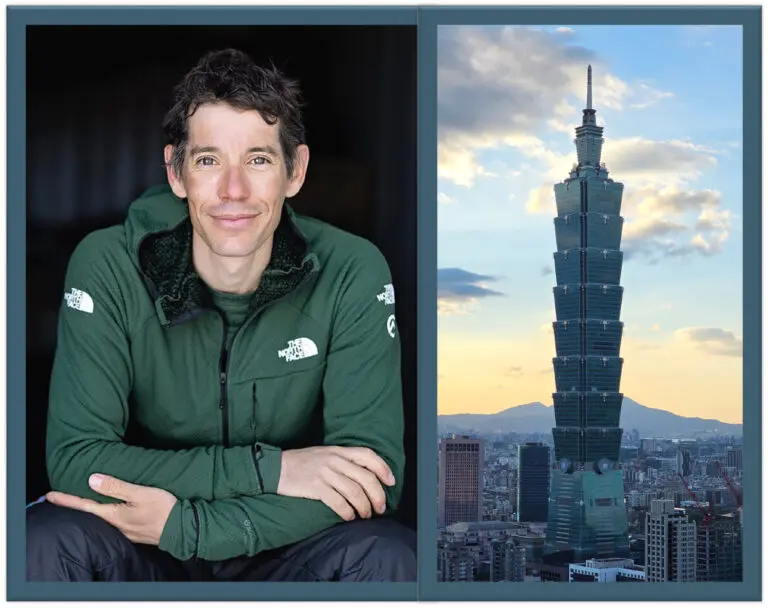
Recently, a scene resembling a movie special effect unfolded on the exterior walls of Taipei 101—an event witnessed by thousands on-site and tens of thousands via livestream. International climber Alex Honnold (born 1985) successfully reached the summit of Taipei 101 without mechanical aids or safety gear. Throughout the climb, the only equipment that appeared repeatedly was a small bag of white powder at his waist. Every time he paused or switched hands, he reached into that chalk bag. This powder isn’t magic; it is a common substance found in daily life: magnesium carbonate (MgCO3).
Why is Magnesium Carbonate Needed for Climbing?
When ascending, the primary enemy is gravity. Therefore, a climber clinging to a wall must rely on static friction to counter gravity. The upper limit of static friction can be expressed as Fmax = μsN, where N is the normal force of the fingers pressing against the wall, and μs is the coefficient of static friction. A climber cannot change Earth’s gravity and has limits on how much they can increase the normal force (N). Furthermore, during the physical exertion of climbing, the palms produce sweat and sebum. These liquids form a “fluid film” between the skin and the wall, acting like a lubricant that reduces the effective coefficient of static friction (μs), making it easier for the hands to slip and significantly increasing the difficulty of the climb.
This is where magnesium carbonate comes in. Because it is highly effective at absorbing water and oils, the powder disrupts the lubrication layer, returning the interface from “wet friction” back to a “dry friction” state. This maintains the original static friction coefficient and prevents the hands from sliding off the surface.
To more precisely understand the mechanism, Tohoku University published a study in 2015 titled “Effect of Chalk on the Stability of Finger Friction in Rock Climbing.” The study did not just focus on the average friction force; it introduced the “standard deviation of sliding velocity” as an indicator. This is because what often causes a climber to fall is not a lack of average friction, but a sudden, unpredictable drop in friction. The results showed that under dry conditions, using magnesium carbonate reduced the standard deviation of sliding velocity by about 42%; in humid environments, the reduction reached 66%. This indicates that magnesium carbonate makes the contact between the hand and the wall more stable, entering a “predictable and controllable” state.
However, some scientific research has pointed to contradictory results. In 2001, a study from the University of Birmingham suggested that applying magnesium carbonate might actually decrease the friction coefficient. The researchers proposed several reasons: first, over-drying can cause the skin to harden, reducing the actual contact area. Second, if too much powder is used, it can form a granular layer at the interface that acts like tiny ball bearings, making sliding easier. These issues occur more frequently on relatively smooth surfaces. Therefore, magnesium carbonate is not a panacea; it is a conditional tool. The surface material, environmental humidity, sweat levels, and the amount of chalk used all determine whether it helps or hinders. Fortunately, in the context of real rock faces (and the exterior of Taipei 101), magnesium carbonate serves its purpose in defying gravity.
Magnesium Carbonate in Daily Life
Most of us are not professional climbers, yet many are frequent users of magnesium carbonate. It is commonly used in cosmetics and oral care products. In cosmetics, its moisture-absorbing properties help control oil and set makeup. Some toothpastes use magnesium carbonate as a mild abrasive to help clean stains and plaque while utilizing its absorbent properties to improve breath. In the food industry, it is often used as an anti-caking agent to keep powdered products dry and free-flowing. Some have questioned what happens to the residue left on Taipei 101 after Honnold’s climb. Essentially, magnesium carbonate is a non-toxic powder that is slightly soluble in water. In water containing carbon dioxide (like rainwater), it converts into soluble magnesium bicarbonate (Mg(HCO3)2). A single rainstorm is enough to wash the walls of Taipei 101 clean.
High-Tech Applications of Magnesium Carbonate
In addition to climbing and daily use, magnesium carbonate has recently been introduced into cutting-edge technological applications, becoming a material for energy systems that can both “store energy” and “capture carbon.” A 2026 study published in ACS Sustainable Chemistry & Engineering, titled “Thermochemical Heat Storage Biogel with Environmental Friendliness for Solar‑Powered Heavy Oil Recovery and Carbon Capture,” pointed out that encapsulating magnesium carbonate in a biogel made from agricultural waste (wheat straw) and sodium alginate allows the material to behave like a “rechargeable battery.”
Think of it this way: magnesium carbonate acts as a reversible chemical battery. During the day, under solar heating, it absorbs thermal energy and changes its form from magnesium carbonate to magnesium oxide (MgCO3 → MgO). This is like “charging” the battery by storing energy in a different state. At night or when temperatures drop, the magnesium oxide reacts with carbon dioxide to revert back to magnesium carbonate (MgO → MgCO3). This process is like “discharging,” slowly releasing the stored thermal energy so the system can continue to provide heat even without sunlight. This discovery makes magnesium carbonate a key material in the pursuit of energy storage and carbon reduction, showing great potential for low-carbon energy systems.
On the rock face, magnesium carbonate helps humans defy gravity; in daily life, it silently maintains dryness and cleanliness; and in the scientist’s laboratory, it is a material used to store energy and fix carbon emissions. Alex Honnold used magnesium carbonate to reach the summit of a skyscraper; will scientists be able to use it to reach the peak of sustainable energy research? We shall wait and see!