
Editor’s Recommendation:
This article systematically explores the optimization effect of a solution-processed MgO buffer layer introduced at the interface between the ZnO electron transport layer (ETL) and the CsPbI₂Br perovskite. The study demonstrates that MgO modification increases perovskite grain size, reduces trap density, improves electron mobility, and achieves a higher open-circuit voltage (Voc) by regulating band alignment. Unencapsulated devices maintained a stable efficiency of 15.3% after 10,000 seconds under maximum power point (MPP) bias. Furthermore, proton irradiation experiments simulating Low Earth Orbit (LEO) environments showed that the devices retained their initial efficiency after 11 weeks, significantly outperforming the control group. This strategy provides new insights into developing low-cost, radiation-resistant, and highly stable inorganic perovskite photovoltaic devices.
1. Introduction
Global energy consumption continues to rise with population growth, making the reduction of fossil fuel dependence key to addressing climate change and environmental pollution. As one of the most cost-effective renewable energy sources, solar photovoltaic technology has made significant progress in recent years. Perovskite solar cells (PSCs) have garnered intense attention due to the rapid increase in their power conversion efficiency (PCE). Since the debut of organic-inorganic hybrid perovskite cells in 2009 with an efficiency of only 3.81%, certified efficiencies have surpassed 27% by 2025, demonstrating broad application prospects. Perovskite materials possess excellent optoelectronic properties, including high absorption coefficients, tunable bandgaps, high carrier mobility, and long diffusion lengths.
Despite continuous optimization through thin-film deposition techniques, interface engineering, and additive engineering, the thermal stability of organic-inorganic perovskites remains a core challenge. For instance, methylammonium-based perovskites degrade above 60°C, and formamidinium-based perovskites easily transition to non-photoactive phases at low temperatures. All-inorganic cesium-based perovskites have become a research hotspot due to their superior thermal stability. While CsPbI3 has an ideal bandgap of 1.73 eV, it suffers from phase instability and high moisture sensitivity. CsPbI₂Br (bandgap 1.93 eV), formed by partially replacing iodine with bromine, achieves a better balance between stability and efficiency. The choice of the electron transport layer (ETL) is crucial for device stability: ZnO offers high electron mobility (approx. 200 cm2V1s1) and suitable energy levels, but defects at the ZnO/perovskite interface often lead to recombination losses. MgO has been proven to enhance performance as an interface modification layer in hybrid perovskites, but its application in all-inorganic Cs-based systems remains to be explored. This study systematically evaluates the interface optimization effect of MgO-modified ZnO on CsPbI₂Br cells for the first time and extends the research to proton irradiation tolerance.
2. Results and Discussion
Morphology and Electrical Characteristics of the Interface Layer
Scanning Electron Microscopy (SEM) showed that MgO deposition did not significantly change the ZnO grain morphology, with both layers having a thickness of approximately 70 nm. Atomic Force Microscopy (AFM) indicated that the introduction of MgO slightly increased surface roughness from 15.29 nm to 18.01 nm. The Contact Potential Difference (CPD) measured by Kelvin Probe Force Microscopy (KPFM) showed a significant negative shift (from -20.46 mV to -285.00 mV), corresponding to an increase in work function from 5.385 eV to 5.649 eV, indicating that MgO effectively regulated the electronic structure of ZnO. X-ray Diffraction (XRD) showed a characteristic MgO peak at 44°, confirming its presence. X-ray Photoelectron Spectroscopy (XPS) revealed a shift in the Zn 2p peak toward lower binding energy, suggesting electron density rearrangement caused by the MgO layer. Ultraviolet Photoelectron Spectroscopy (UPS) confirmed that MgO shifted the Conduction Band Minimum (CBM) of ZnO from -4.1 eV to -4.3 eV, increasing the conduction band offset with the perovskite, which facilitates electron extraction.
Perovskite Film Characteristics
The average grain size of CsPbI₂Br deposited on MgO-modified ZnO increased from 370 nm to 600 nm, while the film thickness remained at approximately 320 nm. XRD showed that the perovskite crystal structure remained unchanged; however, after 72 hours of exposure to air, the MgO-modified samples showed significantly better color stability than the control group. After proton irradiation, Confocal Laser Scanning Microscopy (CLSM) showed increased fluorescence intensity in both groups, likely due to irradiation-induced defect annealing, but the MgO group exhibited higher initial fluorescence intensity, indicating a lower intrinsic defect density.
Device Performance Analysis
Electronic device testing showed that MgO reduced the trap density from 7.3×1015cm3 to 6.4×1015cm3 and increased electron mobility from 3.5×10?3cm2V1s1 to 4.3×103cm2V1s1. The open-circuit voltage (Voc) of the champion cell increased from 1.01 V to 1.20 V, and the short-circuit current density (Jsc) increased from 15.1 mA cm2 to 16.4 mA cm2. The average efficiency improved from 8.4% to 9.9%. The External Quantum Efficiency (EQE) response was enhanced in the 350-640 nm range. In steady-state MPP tests, the MgO device efficiency stabilized at 15.3%, significantly higher than the 10.4% of the control group.
Stability and Radiation Tolerance
After 7 weeks of storage in a glovebox, the efficiency of the control group decayed by 58%, while the MgO group decayed by only 40%. Eleven weeks after proton irradiation, the MgO devices maintained their initial efficiency, while the control group dropped to 47%. The study suggests that the MgO layer significantly enhances environmental stability and radiation tolerance by strengthening interface bonding and reducing ion migration paths.
3. Conclusion
MgO interface engineering effectively optimizes grain growth, energy level alignment, and charge transport performance in CsPbI₂Br cells. The induced large conduction band offset promotes electron extraction and reduces non-radiative recombination. Unencapsulated devices demonstrated excellent stability under ambient air and proton irradiation conditions, providing technical support for the application of inorganic perovskite cells in extreme environments such as aerospace photovoltaics.
4. Experimental Methods
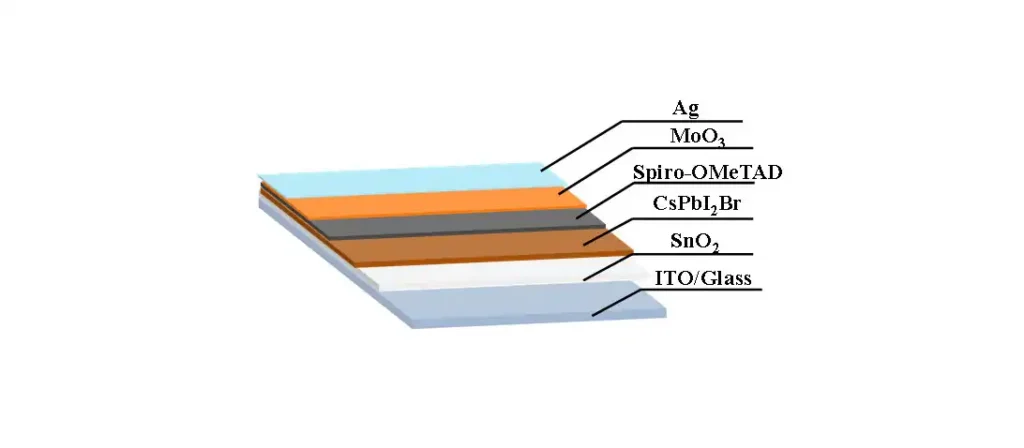
The device structure used was FTO/ZnO/MgO/CsPbI2Br/Spiro-MeOTAD/Au. The MgO precursor was prepared by dissolving magnesium acetate in 2-methoxyethanol with the addition of ethanolamine, followed by spin-coating and annealing at 450°C. The perovskite solution was prepared by dissolving CsI、PbI2, and PbBr2 in DMF/DMSO, using an isopropanol anti-solvent to assist crystallization. Proton irradiation experiments were conducted using a 170 keV pulsed ion beam with a fluence of 2×1012cm2. Characterization methods included SEM, XRD, and Space Charge Limited Current (SCLC) tests.