
Background and Overview
Magnesium stearate belongs to the class of stearates, also known as magnesium octadecanoate, and possesses the dual characteristics of both metal salts and stearic acid. Magnesium stearate is widely used in the pharmaceutical industry as an important lubricant for pharmaceutical tablets. It can also be used as an additive in cosmetics, paints, and plastics, while food-grade magnesium stearate is utilized as a food processing aid. Magnesium stearate serves as an excellent lubricating, dispersing, and stabilizing agent for plastics and rubber, a mold release agent for plastic products, and a high-temperature resistant dusting powder for rubber products. It can also be used as a PVC heat stabilizer to increase the transparency or translucency of the products. In addition, magnesium stearate can be used as a drier and flatting agent in the paint industry; as a mold release agent, activator, stabilizer, lubricant, and softener in polymer materials; and as a high-temperature solid lubricant in the machinery industry. With social progress, the scope of application of magnesium stearate continues to expand, and domestic demand is also growing, showing a year-on-year upward trend.
Applications
As a metallic soap, this product possesses the general characteristics of metallic soaps and can be used as a stabilizer for plastics; a lubricant; a flatting agent and catalyst for paints; a mold release agent; a raw material for cosmetic dusting powders and moisturizing creams; an external lubricant for plastic products; and a food anti-caking agent and emulsifier. Magnesium stearate is widely used as a pharmaceutical excipient and is generally considered non-toxic when administered orally. In the production of capsules and tablets, it is primarily used as a lubricant and excipient, typically at a concentration of 0.25% to 5.0% (w/w). Examples of its applications are as follows:
- Preparation of magnesium stearate-modified magnesium powder for magnesium-rich primers: Corrosion protection using magnesium-rich primers, as an alternative to chromium-free corrosion protection technologies, has broad application prospects in many fields, particularly in aerospace. The corrosion protection of magnesium-rich primers on aluminum alloys relies on a sacrificial anode cathodic protection strategy. That is, when the corrosive medium penetrates the coating and reaches the interface between the magnesium-rich primer and the aluminum or aluminum alloy substrate, because the corrosion potential of magnesium is lower than that of aluminum and its alloys, magnesium reacts with the corrosive medium first, thereby preventing corrosion of the substrate metal. Magnesium stearate-modified magnesium powder can be obtained by dispersing magnesium powder into a butyl acetate solution of magnesium stearate with stirring, and this modified magnesium powder is used to prepare the magnesium-rich primer.
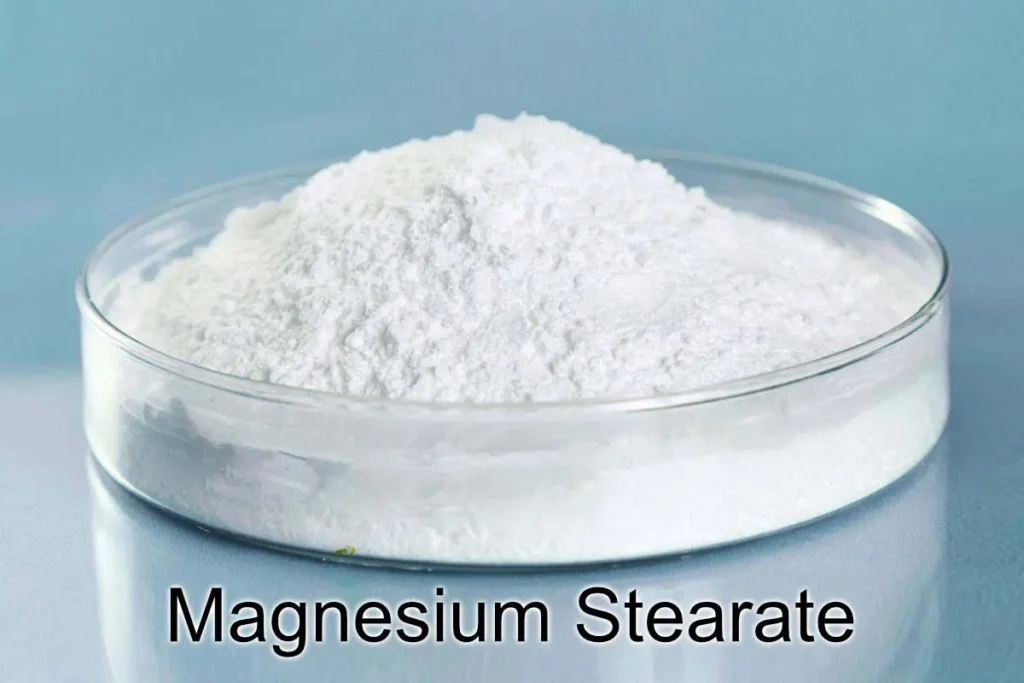
- Pharmaceutical excipient application: As a pharmaceutical excipient, magnesium stearate is a white, loose, non-gritty fine powder that feels greasy to the touch and easily adheres to the skin. It is used as a lubricant, anti-adherent, and glidant. It is particularly suitable for the granulation of oily or extract-based drugs, producing granules with good flowability and compressibility. Its soft texture helps fill in the depressions on the surface of the granules, which weakens the mechanical interlocking effect between the granules and allows them to slide past each other more easily. The particle size, flowability, and dispersibility of magnesium stearate directly affect the moldability and compactibility of the prepared pharmaceuticals.
Preparation
Method 1: Preparation of magnesium stearate is conducted as follows:
- S1: Take glyceryl tristearate (tristearin) and stir during feeding. Maintain the temperature at 100°C. After the glyceryl tristearate is completely melted, add Catalyst A, antioxidants, and water. Perform the hydrolysis reaction at a temperature of 130°C and a pressure of 0.7 MPa. Let the hydrolysis product stand for 45 minutes for oil-water separation. Perform pressure filtration on the oil phase to recover the catalyst, yielding stearic acid.
- Ratios: In Catalyst A, the mass ratio of magnesium oxide to Al2O3-MgO is 1:8, and its dosage is 4% of the mass of glyceryl tristearate. Al2O3-MgO is prepared via precipitation, with an Al2O3 to MgO molar ratio of 2:1. In the antioxidant mixture, the mass ratio of Antioxidant 1076 : Antioxidant DLTDP : Antioxidant T501 is 0.5:0.65:1, and its dosage is 0.5% of the mass of glyceryl tristearate. The mass ratio of glyceryl tristearate to water is 1:0.5.
- S2: Add the stearic acid obtained in S1 into a magnesium stearate reactor, maintaining the temperature at 100°C. Add magnesium oxide (equivalent to 4% of the mass of glyceryl tristearate) while stirring. After feeding is complete, raise the temperature of the material to 110°C, add Catalyst B (equivalent to 5% of the mass of glyceryl tristearate), and stir to react for 25 minutes. Catalyst B is a mixture of hydrogen peroxide and magnesium peroxide with a mass ratio of hydrogen peroxide to magnesium peroxide of 5:1.
- S3: Add magnesium oxide (equivalent to 1.5% of the mass of glyceryl tristearate) and Catalyst B (equivalent to 1% of the mass of glyceryl tristearate). React at a temperature of 120°C. Stop stirring. After the material foam subsides to an equilibrium point, add an additional portion of Catalyst B (equivalent to 1% of the mass of glyceryl tristearate) and react at 130°C for 20 minutes.
- S4: Add sodium hydroxide (equivalent to 0.1% of the mass of glyceryl tristearate) while stirring, and react at a constant temperature for 10 minutes.
- S5: Turn on the vacuum pump, adjust the vacuum degree to -0.08 MPa, and dehydrate. Stabilize the reaction under constant temperature and pressure for 60 minutes to terminate the reaction. Sample and test the product. After passing quality control, the product is pulverized/powder-sprayed and packaged to obtain magnesium stearate with a yield of 95.23%.
Method 2: A method for preparing pharmaceutical-grade magnesium stearate with low heavy metal, sulfate, and chloride content:
- (a) Add food-grade magnesium stearate to a dissolution tank, add anhydrous ethanol, and stir at a temperature of 50–70°C and a stirring speed of 100–150 rpm for 15–30 minutes to achieve complete dissolution, wherein the mixing ratio of magnesium stearate to anhydrous ethanol is 1:10 (g/ml).
- (b) Add 10–20 g/L of iron-modified sepiolite adsorbent to the solution obtained in step (a), perform oscillatory adsorption for 2–3 hours, and filter.
- (c) Distill the filtrate under reduced pressure at a temperature of 60–70°C to recover the ethanol, and collect the product.
- (d) Add the obtained product to a dissolution tank, add purified water, and stir at a temperature of 70–90°C and a stirring speed of 100–150 rpm for 15–30 minutes to wash thoroughly, wherein the mixing ratio of magnesium stearate to purified water is 1:8 (g/ml).
- (e) Filter, separate the solids, and discard the filtrate.
- (f) Dry the separated material in an oven at 70–90°C for 4–6 hours.
- (g) Pulverize and sieve the dried material, inspect, and package to obtain the final product.