
Rubber hoses are indispensable rubber products in the national economy, and their applications cover engineering machinery, mining, metallurgy, petroleum, chemical industry, automotive, aviation, navigation, construction, agriculture and forestry, medical treatment, household appliances and other fields. In recent years, the main development trends of rubber hose products at home and abroad are large length, large diameter and high pressure. All industries have put forward higher requirements for high temperature resistance, low temperature resistance, flex fatigue resistance, special medium resistance and increased flow rate. These requirements are embodied in the braiding & winding and resinification of rubber hoses. These two trends interact, promote and drive the development of the rubber hose industry.
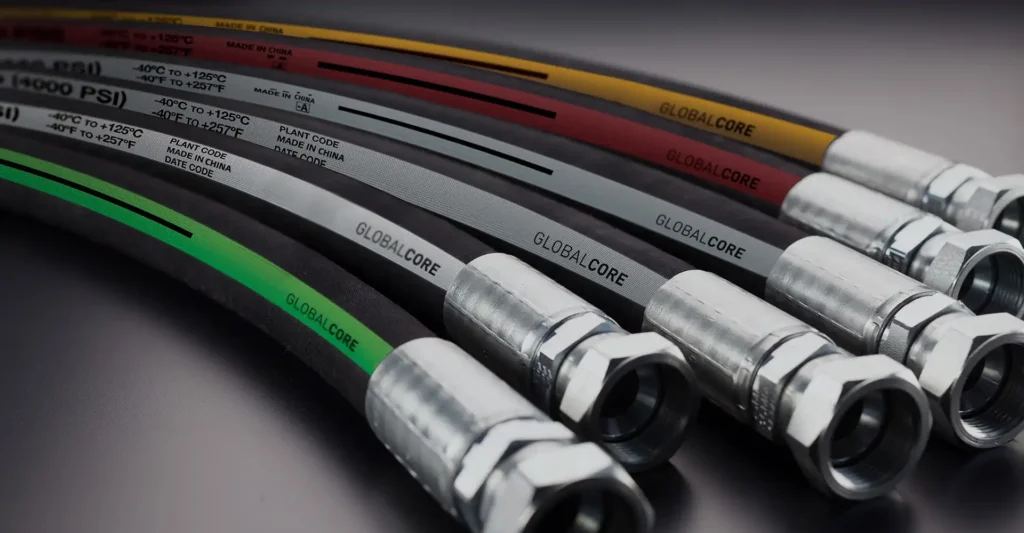
Since the 1980s, the tooling level of rubber hoses has developed by leaps and bounds. Equipment such as high-speed precision steel wire winding machines, rotary steel wire/yarn weaving machines, short fiber reinforced rubber hose extruders, large-diameter rubber hose forming machines, resin wrapping machines, nylon water cloth winding and unwinding machines, automatic thickness/diameter measuring and controlling devices, and continuous vulcanizing devices have emerged successively, which have greatly improved the production speed, precision and quality of rubber hoses.
Polymer materials for rubber hoses have expanded from rubber to plastics. A considerable number of hoses, especially medium and low-pressure hoses, widely use thermoplastics as inner lining and outer covering layers. Reinforcing materials are mainly steel wire, nylon and polyester, and aramid fibers have been applied in a small number of rubber hoses. Some special rubber hoses use steel wire cords or steel wire ropes, and some even adopt interlocked coiled steel strips as reinforcing materials.
Computers have been successfully applied in the design of rubber hose structures, extrusion die design and rubber compound formulation design, accelerating the development of new rubber hose products.
1 Current Status of Rubber Hose Products at Home and Abroad
1.1 Strategic Trends of Foreign Rubber Hose Manufacturers
In recent years, some foreign rubber hose manufacturers have adjusted their strategies, mainly involving two aspects: production transfer to low labor cost regions and internal restructuring, aiming to improve profits and maintain a leading position in certain fields.
1.1.1 Production Base Transfer
Production bases have moved eastward to Eastern Europe, East Asia and Southeast Asia, driven by labor costs and proximity to customers.
Manuli, an Italian company specialized in automotive air conditioning hoses, holds about 12% of the European market share. In 2001, the company transferred all production equipment from its Dutch plant and part from its Italian plant to Poland, gaining a competitive advantage due to lower production costs.
Germany’s Phoenix built a rubber hose plant in Romania and a logistics center in Hungary to handle all business in Eastern Europe.
Japan’s Tokai Rubber Industries established three wholly-owned rubber hose plants in Dalian, Tianjin and Guangzhou, China, aiming to cover the automotive markets in North, East and South China.
Germany’s ContiTech set up two joint-venture rubber hose plants in Shanghai and Changchun, China, producing automotive power steering hoses and air conditioning hoses for GM and Volkswagen.
1.1.2 Focusing on Advantageous Fields
To maintain market dominance, major foreign rubber hose companies concentrate their advantages on one or several fast-growing sectors.
Germany’s Phoenix is a leader in automotive fluid transmission systems (heating and cooling hoses, air supercharger hoses, fuel hoses, air conditioning hoses) and special hoses (inland and offshore oil industry hoses, concrete placement hoses, etc.). Therefore, the company focused its technical resources on these two areas and sold two hydraulic hose plants that did not hold a prominent position in the industrial hose market, with annual sales of about 10 million euros each in Germany and Malaysia, reflecting a strong restructuring effort.
Another adjustment is transforming branch companies that originally only produced and supplied hoses into pipeline assembly system branches, such as fuel pipeline systems, air conditioning pipeline systems and power steering pipeline systems with assembled hoses, which can improve profits and facilitate assembly for manufacturers.
1.2 System Reform of China’s Rubber Hose Enterprises
System reform is steadily progressing in China’s rubber hose industry, promoting enterprise development and enhancing vitality. The reform takes various forms, including joint ventures with foreign investors, enterprise restructuring and internal organizational adjustment.
Typical cases include the system reform of the Shanghai rubber industry. About 200 rubber hose enterprises in Zhejiang Province have completed restructuring, with two-thirds adopting the shareholding system. Yichang Zhongnan Rubber Group privatized its affiliated factories through external investment and leasing.
Internal organizational restructuring and business model reform have revitalized enterprises. Northwest Rubber General Factory established a special rubber hose company under the joint-stock cooperative system. Kaifeng Iron Tower Rubber Group Co., Ltd. carried out organizational restructuring, transforming its No. 3 Branch into Iron Tower High-Pressure Rubber Hose Co., Ltd. as a shareholding enterprise, reviving the production of steel wire braided hoses.
Joint ventures with foreign enterprises have also developed rapidly. The joint venture between Shenyang No. 4 Rubber Factory and Parker of the US, Shenyang Adiya Rubber Products Co., Ltd., has operated for more than three years with steady growth in sales and profits. In 2000, ContiTech established ContiTech Fluid Shanghai Co., Ltd., producing automotive power steering hoses for ContiTech and GM. ContiTech also formed a joint venture with Changyang Dayang Rubber Hose Factory – ContiTech Grand Ocean, mainly producing automotive air conditioning hoses and power steering hoses for Volkswagen, Jetta, BORA and Audi A6, which started production in 2002.
Wholly foreign-owned rubber hose enterprises have also emerged in China. Japan’s Tokai Rubber Industries invested 3.7 million US dollars to acquire the rubber hose production division of a Dalian factory and established Tokai Dalian Rubber Hose Co., Ltd., producing ordinary hoses (one or two layers), fuel hoses, exhaust emission hoses and wastewater discharge hoses. Tokai also founded Tokai Rubber (Tianjin) Co., Ltd. and is preparing Tokai Rubber (Guangzhou) Co., Ltd. to manufacture automotive hoses.
1.3 Latest Progress of Rubber Hose Products
1.3.1 Automotive Rubber Hoses
In recent years, the most researched field of rubber hoses abroad has been automotive hoses. Since the 1970s, the automotive industry has undergone major changes: fluctuating fuel costs, replacement of refrigerants, smaller engine compartments with compact components, and significantly increased under-hood temperatures. In addition, environmental regulations limit fuel and refrigerant emissions. Therefore, hoses are required to withstand higher temperatures, resist new fuels and refrigerants, and feature lower permeability.
(1) Fuel Hoses
The inner layer of fuel hoses traditionally uses NBR. With the use of oxygenated fuels and electronic injection systems, lower permeability is required. Most inner layers now adopt a composite structure: a thin FKM (fluororubber) lining inside the NBR layer, or a thin polyamide layer outside, forming a double-layer structure.
(2) Air Conditioning Hoses
Changes in air conditioning hoses are mainly caused by refrigerant replacement. The original CFC-12 has been replaced by HFC-134a, and the lubricant has been changed to polyalkylene glycol (PAG). To resist high temperature and refrigerant permeation, the inner rubber layer has been switched from NBR to IIR or HNBR, and some are lined with a thin polyamide layer.
Thermoplastic Nylon 11 was initially used for automotive air conditioning hoses but has been mostly phased out, as rigid nylon transmits noise and vibration from the compressor and engine to the cab, while rubber hoses avoid this drawback.
(3) Turbocharger Hoses
Diesel engines are increasingly used in automobiles due to lower volatility than gasoline. Both diesel and even gasoline engines are equipped with turbochargers, requiring hoses to deliver air. One end of such hoses typically withstands 210°C and the other 160°C, demanding excellent heat resistance. The structure consists of silicone rubber inner lining, fluororubber inner layer, aramid fiber reinforcement and silicone rubber outer layer.
1.3.2 Offshore Oil Hoses
Offshore oil hoses are divided into three categories: floating, semi-floating and subsea hoses.
Floating oil hoses are usually integral floating types with sponge floating bodies, used for crude oil transmission between single-point mooring buoys, oil tankers or the shore.
Phoenix’s double-body structure is the most advanced integral floating hose, with a main body and a secondary body unbonded to each other, and a floating body outside the secondary body. An electronic sensing alarm system is installed between the two bodies. If the main body ruptures, crude oil enters the gap, causing local bulging and triggering audible and visual alarms, allowing low-pressure continued operation before replacement.
Semi-floating hoses share the same main structure as floating hoses, except that floating bodies are installed after forming. Different numbers of external floating bodies can be fitted according to required buoyancy, usually used between underwater single-point mooring buoys and subsea pipelines.
The most advanced subsea oil hoses are manufactured in France, with interlocked coiled steel strip reinforcement and polyurethane outer covering, suitable for long-term subsea service.
1.3.3 Research and Development of New Rubber Hose Products in China
China’s rubber hose industry has made substantial efforts in R&D, achieving encouraging results that promote technological progress and bring good social and economic benefits. Table 1 lists some new products developed in China in recent years.
1.3.4 Production Scale of China’s Rubber Hose Industry
China’s rubber hose industry now has more than 700 manufacturers, including over 140 with a certain production scale, distributed in all provinces, municipalities and autonomous regions except Xizang. The product range is increasingly complete, basically meeting domestic demand. Production technology and equipment, developed independently or imported, are continuously improving. Product performance and quality comply with international, national and industrial standards. Output is growing year by year, and some products have entered the international market with increasing exports. China has become a major rubber hose producer. Although there is still a gap in some aspects compared with developed countries, the industry has reached a relatively high international level.
Since the 21st century, China’s rubber hose output has kept rising. According to the National Bureau of Statistics, data from 110 major enterprises underrepresent the actual total output, as many small and some medium-sized enterprises are not included. About 40 of the surveyed enterprises produce more than 1 million standard meters, accounting for about 35%.
2 Progress in Production Technology of Steel Wire Rubber Hoses at Home and Abroad
2.1 Steel Wire Braiding Machines, Winding Machines and Stranding Machines
In recent years, steel wire braiding and winding machines have been improved with higher speed and efficiency.
Magnatech’s RB-2 rotary steel wire/yarn braiding machine is available in 16, 20, 24 and 36 spindles. Steel wire braiding speeds are 90, 80, 69 and 45 r/min; yarn braiding speeds 100, 90, 75 and 50 r/min. Production rates are 1.6, 1.8, 3.0 and 2.5 m/min for steel wire, and 1.8, 2.0, 3.3 and 2.8 m/min for yarn.
Magnatech has launched the new WSW-Ⅳ steel wire winding machine. It accommodates 6, 5, 4 and 3 steel wires per spindle, with capacities of 2.95, 3.7, 5.0 and 7.0 kg and 180, 150, 120 and 90 wires per spool. At 100 r/min, production rates are 11.3 m/min (24.0 mm winding diameter) and 4.2 m/min (19.0 mm).
Both WSW-Ⅲ and WSW-Ⅳ run at 100 r/min (33% higher) with a total capacity of 635 kg (180 wires). WSW-Ⅳ supports three presetting devices (standard, soft core, large diameter) and reduces changeover time by 50% to 30–40 minutes, improving efficiency. It can produce hoses with outer diameters of 7.6–64 mm.
A new type of steel wire winding machine has appeared in Europe with 24 or 36 spindles, similar to Magnatech’s model but differing in spindle and winding head design. Multiple steel wires are laid as a strip, similar to braiding, using a stranding machine instead of a wire guide.
Magnatech introduced the BW-7-ELC steel wire stranding machine with electronic length control. Maximum spindle speed is 2250 r/min, production rate 520 m/min, strip width 10 mm, holding 3–36 wires of 0.2–0.6 mm. Equipped with a single-board computer and operator interface, it controls servo speed and rotation for correct lead and traverse length. Operators input parameters, and the machine automatically sets values and adjusts during operation, supporting remote data monitoring via RS-232.
2.2 Forming Processes
The three traditional steel wire braided hose forming processes each have pros and cons. The hard core method limits length and efficiency but ensures stable quality and accurate dimensions. The soft core method produces smooth, accurate hoses with increased length, suitable for large-length hoses under 38 mm. The coreless method uses compressed air or low-pressure water, with simple process, high efficiency and long-length production, but suffers from difficult dimension control, blistering and unstable performance.
In the early 1980s, fixed mandrel and rotary mandrel extrusion processes emerged. The fixed mandrel process (British patent) uses a porous hollow hard mandrel fixed to the extruder. Pressure fluid forms a lubricating layer between the mandrel and inner rubber, allowing movement before braiding. The rotary mandrel process integrates the mandrel with the extruder screw for inner layer extrusion and braiding. Both extend the coreless method without semi-vulcanization and ensure accurate dimensions.
2.3 Rubber Compounding
Steel wire braided hoses mainly fail by bursting or joint breakage. Besides environmental and medium resistance, the rubber requires high modulus, dynamic fatigue resistance, tear strength and low compression set.
2.3.1 Rubber Selection
The inner layer is chosen according to medium and temperature. Besides NBR, IIR, FKM, HNBR and modified nylon are used for low permeability, often coated with thin FKM or modified nylon layers to reduce cost.
The middle layer uses low-acrylonitrile NBR or CR. Blending with SBR or CR improves adhesion to copper-plated steel wire.
The outer layer traditionally used CR, now widely replaced by EPDM, IIR, NBR blended with CSM, chlorinated polyethylene or ECO for better weather, ozone and low-temperature resistance.
2.3.2 Vulcanization System
NBR usually uses a sulfur vulcanization system with thiazole and sulfenamide accelerators. For NBR/CR blends with higher CR, the CR system applies. Combined ZnO and MgO improve vulcanization and adhesion; MgO also enhances heat and compression resistance.
2.3.3 Reinforcing and Filling Agents
HAF, GPF, SRF and fast extrusion carbon black are commonly used. A large amount of spray black provides balanced mechanical, low-temperature and extrusion properties with a smooth surface. White carbon black in the middle layer improves steel wire adhesion.
2.3.4 Adhesion System
The resorcinol-formaldehyde-resorcinol (RF) resin, HMMM and white carbon black system enhances NBR adhesion to copper-plated steel wire, with white carbon black as the key factor.
Cobalt salts significantly improve adhesion. Cobalt borate combined with adhesive AS-88 in the middle layer achieves excellent bonding.
2.3.5 Softeners
Excessive softeners harm adhesion. Esters are preferred, with aliphatic dibasic acid esters (e.g., DOA) outperforming phthalates; blending yields better results.
2.3.6 Antioxidants
Antioxidants have little direct effect on adhesion, but antioxidant BLE acts as a special tackifier for NBR and copper-plated steel wire, used in the middle layer to improve bonding.
2.3.7 Reinforcing Materials
Two chemical fibers may replace steel wire for lighter, more flexible and high-strength hoses.
Aramid fiber offers steel-like strength, fiber flexibility, low density, high modulus, high strength, small deformation, corrosion resistance, high temperature resistance and flame retardancy (stable at 300°C, decomposes above 550°C). Plasma treatment improves adhesion to rubber.
POK fiber (polyketone fiber, Shell) features ultra-high strength and modulus, with a strength index of 200 and modulus index of 250, excellent heat resistance, low shrinkage, no impregnation needed and good rubber bonding.
2.4 Rubber Hose Structure Design
Steel wire braided layers are usually woven at the equilibrium angle (54°44′), offering good pressure resistance, flexibility and material efficiency. However, this angle is less suitable for multi-layer thick-walled high-pressure hoses. Burst efficiency drops from ~80% for one layer to ~75% for two, ~65% for three and below 50% for four or small-diameter three layers. Stress concentrates on inner layers, causing fatigue failure while outer layers remain intact.
For multi-layer braided hoses, the inner layer angle is slightly smaller than the equilibrium angle and the outer layer slightly larger, known as the “matching angle” structure, optimizing stress distribution. The “optimal angle sequence” design eliminates mechanical unevenness, while large-variable-angle equal-strength design reduces length change in static tests and swing amplitude in pulse tests.
2.5 Vulcanization of Rubber Hoses
Hard-core hoses are still vulcanized with wrapped water cloth, mostly nylon cloth. Soft-core hoses can also use nylon cloth with dedicated winding/unwinding machines.
Soft-core steel wire braided and yarn hoses were traditionally vulcanized by lead wrapping for dense walls and smooth surfaces. Resin wrapping vulcanization was patented in the 1980s but only widely used recently due to environmental concerns. Its principle is similar to lead wrapping, with recyclable resin.
Domestic resin wrapping equipment is available at a much lower investment (180,000 RMB vs. 1,960,000 RMB for lead wrapping) and lower melting point (235–300°C vs. 327°C) with equivalent performance.
Pressurized Liquid Salt Bath Continuous Vulcanization (PLCV) is a breakthrough for hydraulic hoses. Compared with lead wrapping, it saves energy, shortens cycles, improves quality and greatly increases pulse life, with no lead pollution and treatable wastewater. It completely removes air between rubber and steel wire layers, preventing delamination caused by bubbles.
2.6 Automatic Thickness Measurement and Control in Rubber Hose Production
Automatic thickness and diameter measurement and control is critical for uniform inner layer dimensions and is widely applied. Commercial laser and ultrasonic devices are available.
2.7 Application of Computers in Structure and Compound Design
In developed countries, computers are widely used in rubber hose and rubber product manufacturing.
Dunlop developed three FEA models for structural analysis of hose fittings, hose bodies and assembly interfaces. Computer FEA of offshore oil hoses identified performance factors and optimized design, ensuring performance and safety under harsh offshore conditions.
Computers are also widely used in compound formulation design with specialized software. Designers optimize formulations based on performance requirements and material databases, simulate on computers, then conduct laboratory tests and pilot production before mass production, optimizing formulations, reducing costs and shortening development cycles.
3 Conclusion
In recent years, progress in the high-pressure rubber hose industry is mainly reflected in production equipment, rubber compounding technology and the wide application of computers.
Advances in production equipment focus on the speed and precision of steel wire braiding and winding machines.
Progress in rubber compounding is mostly embodied in automotive hoses.
Computer technology is applied in structural design, formulation design, extrusion die design and extrusion simulation, playing an important role in improving performance, shortening cycles and reducing costs.
The advancement of the rubber hose industry is also reflected in enterprise system reform, organizational restructuring and asset reorganization, which play important and even critical roles.